Deep Sea Frenzy Slot Review
by Pragmatic PlayReleased Oct 5, 2026
A shark collector from Pragmatic Play where the money symbols in the bonus are worth the spin you are on, 1x on the first and 200x on the twelfth, so the card that sets your five to eight spins matters more than anything that lands on the reels.

Specifications
| Game Type | Slots |
|---|---|
| RTP | 96.52% |
| RTP Range | 94.51 / 95.51 / 96.52 |
| Volatility | Medium |
| Max Win | 16,000x |
| Grid | 5x4 |
| Paylines | 50 |
| Min Bet | $0.25 |
| Max Bet | $400 |
| Hit Freq | 33% |
Pragmatic Play has built another fish-collector, swapped the bass for sharks, and changed the one thing that makes a collector a collector: inside the bonus the money symbols carry no random value at all. They are worth the number of the spin you are standing on. Spin one pays 1x the bet per shark; spin twelve pays 200x. The fish never change, only the clock does, so the entire game becomes a question of how long a round can be made to last.
The board is 5x4 with 50 fixed lines, out on 5 October 2026, at 96.52% RTP with a 16,000x ceiling and medium volatility. It arrives as a calm blue seabed with a meditation soundtrack - a strange wrapper for a game whose collect symbol is a shark lunging at the screen with its jaws open.

The base game between features
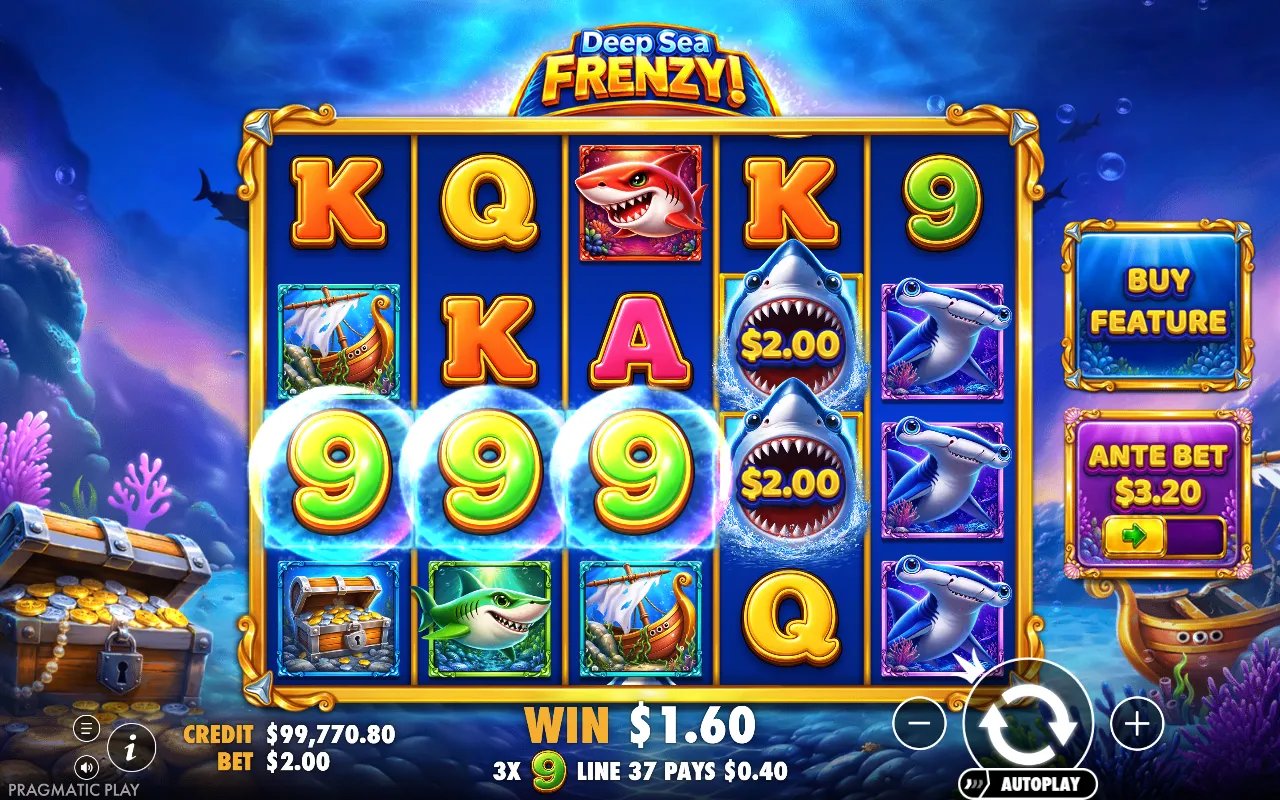
Two games run on the same reels; in our seven spins only the line game paid. The first is a plain 50-line slot: three of a kind from the left, royals at the bottom, a longship and a treasure chest in the middle, three cartoon sharks at the top. The three sharks pay from two of a kind, which nothing else on the board does; it is why the game hits about one spin in three - it is also why so many of those hits are tiny. A two-shark hammerhead pays $0.24 on a $2.00 spin. Three 9s pay $0.40. The best line in the paytable, five hammerheads, is 8x the bet - on a game with a 16,000x ceiling, the paylines are pocket money.
The second game is the sharks with cash printed across them. They land on reels one to four carrying anything from 1x to 200x the bet. They are worth precisely nothing unless a collect shark lands on reel five in the same spin with at least eight money sharks beside it; that pays every value on the board, multiplied if the collect is a 2X, 3X or 5X, before the free spins begin. Below eight, the collect does nothing. It just sits there.
That is what the base game mostly is. We played seven spins at $2.00. Five of them paid nothing. The first spin put a +1 SPIN collect on reel five beside a single $2.00 shark; the third put a 3X collect beside two. Both were near misses in the sense that the rare symbol had landed; both were a long way from paying, because two sharks is not eight. The two spins that did pay returned $1.60 for three 9s and $0.80 for three Ks, with money sharks sitting idle on the board both times.

The money ladder
The free spins are where the game stops being Big Bass Bonanza with a different fish. The eight-symbol threshold disappears; any number of money sharks beside a collect pays. And the values on those sharks stop being random. On the first free spin every money shark is worth 1x the bet. On the second, 2x. Then 3x, 5x, 10x, 15x, 25x, 50x, 100x, 150x, 175x, and 200x on the twelfth spin, where the ladder stops and stays for anything after. We watched it happen at a $2.00 bet: sharks printed $2.00 on the first spin, $20.00 with one spin left, $30.00 on the last spin of a six-spin round.
So the classic collector moment, a big number landing on a fish, cannot happen here. A shark on spin three is worth 3x whether it likes it or not. What you are chasing instead is spin count, because the round starts at five spins (six if a +1 SPIN collect triggered it) with no retrigger - the only way to add a spin is another +1 SPIN collect landing during the round. Sharks that land without a collect are lost; nothing sticks, nothing carries forward to the next spin, so a $30.00 shark under an empty reel five is worth exactly nothing.

The buy and the card that sets the ceiling
The buy costs 170x, $340.00 at a $2.00 stake - and what it sells is not a fixed round but a card. Before the spins start you turn over one of four face-down cards: the Ace of Spades is 8 spins, the King of Diamonds 7, the Queen of Hearts 6, the Jack of Clubs 5. That looks like a small flourish. It is the most consequential click in the game, because the spin count is the multiplier: a five-spin round can never pay more than 10x per shark, an eight-spin round tops out at 50x; the card decides which before a reel has turned. We bought twice. We drew the Queen of Hearts both times.
Both rounds had the same shape: a wait, then one spin that mattered. The first round picked up a +1 SPIN collect early and ran to seven spins, paid nothing for three of them, then landed six sharks at $20.00 with a collect for $120.00. The extra spin that followed put four $30.00 sharks on the board with no collect beside them, so they vanished. The round came back $121.20. The second round was leaner still: $7.60 in total before the last free spin, then six sharks at $30.00 with a FRENZY collect for $180.00. It closed at $187.60. Neither purchase paid for itself - $308.80 back on $680.00 - and in both rounds the money landed on $20.00 and $30.00 sharks, the fifth and sixth rungs of a twelve-rung ladder.

What 16,000x actually takes
The 200x rung sits on the twelfth free spin; the most any card sells you is eight. So the top of the ladder is reachable only by landing +1 SPIN collects inside the round, several of them, in a round where a collect landing at all is the event you are waiting for. On top of that the collect can carry a multiplier up to 5x over everything it gathers. A twelfth-spin board full of 200x sharks under a 5X collect is the picture the ceiling is drawn from. When a round does hit 16,000x it stops on the spot, pays, and forfeits whatever spins were left. The game itself says how often it happens: one spin in a hundred million. A win above 1,000x comes one spin in 127,000: that is the figure to read, not the one on the box.

The ante bet
The ante costs 1.6x the normal stake, $3.20 in place of $2.00; what it buys is a lower trigger: seven money sharks with a collect instead of eight, which the game says makes the free spins 1.8x more likely. It also switches the buy button off, so the two ways of shortening the wait are either-or, never both. And it costs nothing in return - the RTP is 96.52% with the ante on, 96.52% buying, 96.52% playing plain. Pragmatic usually shaves a few hundredths off one or the other; here it takes nothing. The top stake is $250 on a plain spin, $400 with the ante on.
Where it sits among the collectors
Deep Sea Frenzy belongs to no series, so its relatives are by mechanic. Frenzy is a genre label rather than a family; Pragmatic's own Strike Frenzy shares the noun and nothing else. The shell is the one Big Bass Bonanza built, money fish on the left, a collector on the right - that game tops out at 2,100x against 16,000x here, which tells you how much the ladder inflates the ceiling. Two weeks before this game, the same studio put out Freya 1000, another cash-collect on a 10,000x ceiling at high volatility. It is the closer cousin, with one difference: Freya's values land on the symbol; this one's land on the spin. Heartbreakers, on this same 5x4 board with the same collect idea, hits 17.83% of spins at low volatility; Deep Sea Frenzy hits 33% and calls itself medium, which the two-of-a-kind sharks at $0.16 to $0.24 a pair explain more than the bonus does.
A calm seabed with something in it
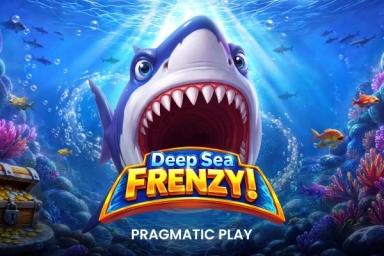
The art is a children's-book ocean: sunlit blue water, coral and pearls on pale sand, a spilled treasure chest, a wreck, three grinning cartoon sharks in coloured frames, and a golden octopus for the wild that lands on reels two to five and never on reel one. The base-game music could sit on a relaxation album; nothing on the reels contradicts it. The one aggressive image in the whole game is the collect symbol, a shark's head breaching out of white water straight at the player, jaws wide - the win screen it triggers is called CHOMP! TIME! The free spins keep the seabed and turn the water violet, with a more predatory track underneath. That is the theme in one joke: a pleasant afternoon interrupted, once a round if you are lucky, by something with teeth.
Pros and cons
For
- The money ladder gives every free spin more weight than the one before it, so a round builds toward its end instead of front-loading.
- 96.52% on plain play, on the ante, and on the buy alike. Nothing is skimmed for the shortcuts.
- Around one base spin in three pays something; the two-symbol shark pays keep the reels from going quiet.
Against
- Money sharks in the base game are decoration until eight of them share a board with a collect. Two of our seven spins put a collect on reel five and paid nothing.
- The buy caps at eight spins and the 200x rung lives on the twelfth, so the number on the box is out of reach without +1 SPIN collects the round has to find for itself.
- Both $340.00 purchases lost, at $121.20 and $187.60; each was one collect away from a $1.20 or a $7.60 round.
- Ante and buy cannot be combined.
Two 170x buys came back $121.20 and $187.60; in each the whole round rested on one collect landing once the sharks had reached $20.00 and $30.00 apiece. That is the game in miniature: a slow blue base that pays in coins, then a bonus where the money is real only in the last few spins, if a shark on reel five shows up to gather it. The idea is a genuine one. Tying the value to the spin number changes what a collector round feels like, since a dead spin early costs little and a dead spin late costs everything. The execution is thinner than the idea, because a round that can be bought never reaches the rungs the ceiling is priced on. Somebody who has played Big Bass Bonanza to its 2,100x top and wants the same reels with a bonus that gets heavier as it goes will find that here, for 170x a round.
Played and reviewed by the SlotsReach editorial team · Published 7 Sept 2026