Fury of Anubis Slot Review
by Pragmatic PlayReleased Jun 29, 2026
Specifications
| Game Type | Slots |
|---|---|
| RTP | 96.52% |
| RTP Range | 96.52 / 95.51 / 94.52 |
| Volatility | Medium |
| Max Win | 10,000x |
| Grid | 6x5 |
| Paylines | Pay anywhere - 8 or more matching symbols anywhere on the 6x5 grid, paid in bands of 8-9, 10-11 and 12 or more |
| Min Bet | $0.2 |
| Max Bet | $240 |
| Hit Freq | 27.85% |
A rare step down in volatility
Pragmatic Play has a very comfortable rut. They build a six-by-five tumbling grid, strip out the paylines, and stamp it with high volatility. Out of nearly eight hundred games in their catalogue, they have used this exact pay-anywhere layout over a hundred times, usually to chase players who want a brutal math model that swings wildly between dead spins and massive payouts. Fury of Anubis dials the temperature down. It is a rare medium volatility release for a studio that prefers them hot, built to test a very specific gamble mechanic that behaves differently depending on how you reached it.
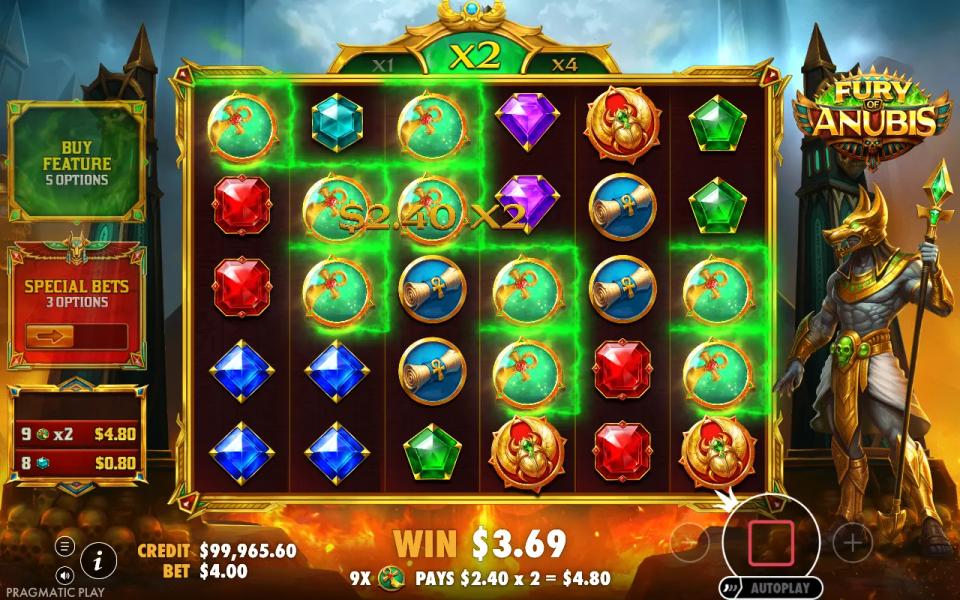
You are sitting in front of the Egyptian afterlife, watching small teal gems and ankhs clatter into place under a live multiplier counter. The whole premise hinges on the scales of Anubis, weighing a heart against a feather to decide your fate before the free spins begin. It is a judgment theme, and the game uses it to quietly judge how you play. If you grind the spins out yourself, the afterlife is surprisingly forgiving, offering better odds the further you push your luck. If you pull out your wallet to skip the line and buy the bonus, the scales are rigged to give you worse odds, printed right there on the screen in plain text.
The baseline numbers
The math model runs at a genuine medium volatility and a 96.52% return, accepting stakes from 0.20 to 240, though operators can drop that return to 95.51% or 94.52%. The hit rate sits at 27.85%, which is a win about every three and a half spins. A natural trigger arrives once in 435 spins, while a win past 1,000x hits once in 130,828 rounds. The ceiling is a hard 10,000x cap that forfeits any remaining spins the moment it hits, and the odds of reaching it are one in 4,840,271.
How the scales are rigged
The board pays whenever eight or more matching symbols land anywhere in view. The paytable is built to be multiplied, not to pay on its own. Eight teal gems return a fifth of the bet, and twelve scarabs, the best hit on the board, stop at 100x. Every win tumbles, and a counter above the reels doubles with each successive cascade, climbing from x2 up to x1,024. The first win of any spin pays flat, and the moment the round ends, the counter drops back to x1. The base game is a steady grind of dead spins and low-paying waits, occasionally returning just over the stake, keeping your balance drifting rather than plunging.

Three Anubis masks trigger ten free spins. Landing four, five, or six scatters hands out the exact same ten spins, but dictates your starting multiplier on the counter, ranging from x8 up to x64. Before the round begins, you face the scales. You can spin a wheel to double that starting multiplier, climbing rung by rung up to x256. Lose the toss, and the free spins vanish entirely, leaving you with nothing. On a natural trigger, the game pays you to be greedy. The odds of winning the gamble climb as you go higher, starting at 50.55% for the first jump and reaching 58.10% for the final step to x256. If you buy your way into the bonus, that climbing ladder is switched off. A flat 50.00% sits under the scales at every rung of a purchased round. The studio actively penalizes you for paying them directly.
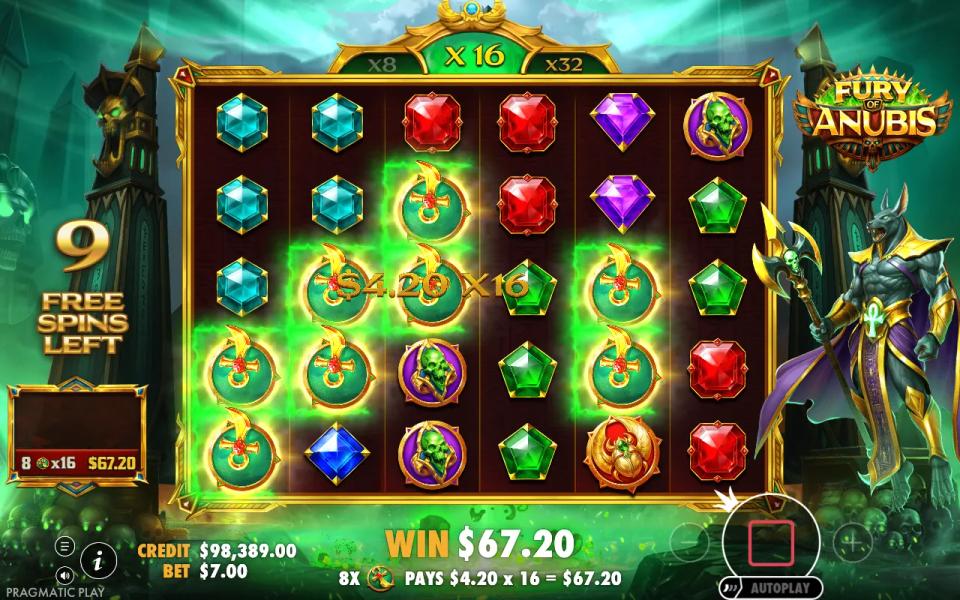
You can buy a guaranteed x8 start for 100x the bet, or pay up to 800x for a x64 start. A 175x random option rolls the dice on your starting rung, and it can land on the cheapest start anyway: bought here, it opened on x8 and gave back 12.8x the bet, while the 100x product returned 19.2x from a single paying spin of ten. What you are buying is the reset rule: during free spins, the multiplier drops back to your starting value before each spin, rather than to x1. More scatters reset the spin count to ten and multiply the start again. It is a powerful engine when a chain connects, but a free spin with no win pays nothing regardless of the multiplier, and most spins die quietly. If you prefer to grind, an ante bet at three times the stake multiplies your trigger chance by ten and changes nothing else.
Shrinking the ceiling
The strangest controls strip the scatters off the board entirely. A 20x super spin starts the tumbling counter at a random rung between x2 and x1,024. A 250x super spin locks the start at x256. Because the 10,000x cap is fixed in cash against your base bet, playing at 250x a spin shrinks the game's absolute ceiling to a 40x hit. The odds of hitting that cap improve to one in 708 spins, but you are risking a massive premium for a brutally flattened top prize.
Pragmatic Play has flooded the market with these pay-anywhere grids, and Gates of Olympus 2500 offers the exact same layout and return with a 25,000x cap for players who want high volatility. Fury of Anubis exists to offer a gentler ride with a sharper gamble. It handles the base game well, providing an honest medium-volatility session that will not bleed a balance dry in minutes. The 10,000x ceiling is a respectable target, heavily dependent on a resetting multiplier doing all the heavy lifting for a weak paytable. The problem is the shortcut. A 50.00% coin toss on a bought round turns a clever, escalating risk mechanic into a flat penalty for using the buy menu, ruining the exact feature that makes the game worth opening in the first place. It is a machine built for the patient player who reaches the scales by landing the masks at an ordinary stake, and then climbs them on the studio's rising odds rather than the flat ones.

Played and reviewed by the SlotsReach editorial team · Published 11 Sept 2026