SlotsReach

Milk and Luck Slot Review

by Mascot GamingReleased Sep 17, 2026

A 6x5 pay-anywhere dairy farm from Mascot Gaming that promises 27,000x on a paytable topping out at 85x, so the money lives in a free-spins multiplier meter that only climbs. The odd part is Risk Mines, a minesweeper gamble on any win with a bear trap under the hay.

Demo player curtain

Specifications

Game TypeSlots
RTP95.8%
VolatilityHigh
Max Win27,000x
Grid6x5
Min Bet$0.2
Max Bet$50
Themes
Features

Mascot Gaming has taken the 6x5 pay-anywhere shape of Gates of Olympus 2500 and moved it to a dairy farm, with a 27,000x ceiling against that game's 25,000x; everything above the paytable's best hit of 85x has to come out of one multiplier meter, which only exists inside the free spins. It is a six-reel, five-row slot with no paylines: eight matching symbols anywhere on the board pay; every win clears itself off the grid in a Rockfall; any green multiplier orbs still on screen are added together and laid over the total once the tumbling stops. Release is set for 17 September 2026. The RTP is 95.80% on high volatility, with a maximum win of 27,000x the bet.

What separates it from the crowd on this board is a gamble called Risk Mines, a grid of hay bales hiding multipliers and a bear trap, offered after every win. What holds it back is the maths of an ordinary spin. Of twelve base spins at 1.00, four paid anything and one finished ahead of its stake; the bonus we bought spent seven of its twelve spins earning 1.50, then one chain took the total from 1.50 to 267.50.

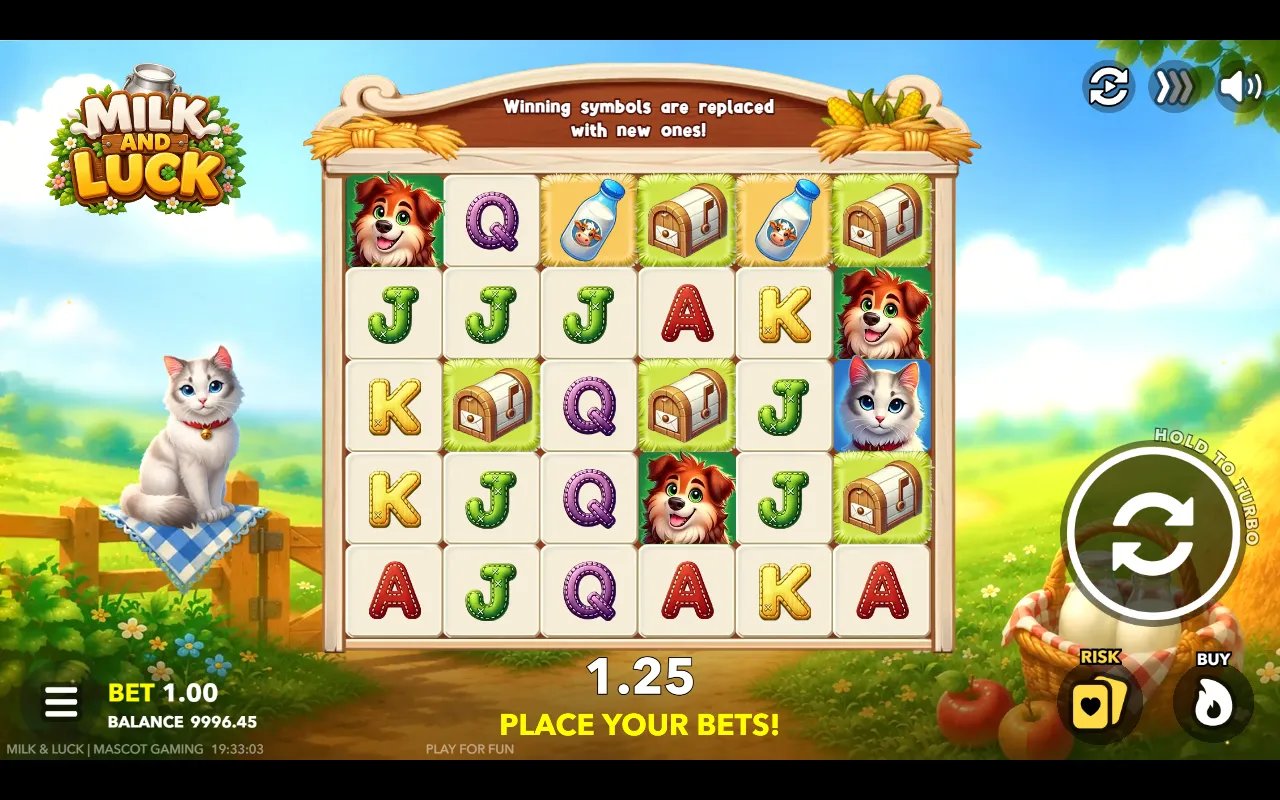
Milk and Luck base game on a 6x5 grid of farm animals and stitched royal letters, showing a 1.25 win after a Rockfall cascade
Two symbols paid on the same board and the Rockfall found a third on the drop that followed - 1.25 back on a 1.00 stake, and the best of twelve base spins.

What a spin does between the features

Most spins do nothing; the ones that pay usually pay less than they cost. A win is eight or more of one symbol anywhere among the thirty positions, adjacency ignored, every qualifying symbol counted, wins on different symbols added together. The table underneath is thin for a game with this ceiling. Eight J's return 0.20x the stake, eight Q's 0.30x, eight cows 3x. The top of the whole table is 85x for twelve cows; twelve is also where the counting stops, since twelve of anything pays the same as thirty. A full screen of one symbol, the thing a cascading grid is supposed to be building towards, is worth exactly what twelve of them are worth.

Every win fires a Rockfall: the paying symbols vanish, new ones drop in from above, the count runs again, until a board comes up dry. Then the orbs are settled. The orbs survive the tumbling; they sit where they landed while the board empties and refills around them. What they do not survive is a blank board. An orb that lands on a spin with no win is cleared away with the next spin, having multiplied nothing; in the base game that is its usual fate.

Our twelve base spins at 1.00 tell it plainly. The second spin put a 3x orb in the middle of a dead board, worth exactly nothing. Spin three paid 0.20 for eight J's, then the RISK button lit up to offer a gamble on it. Spin five built the longest chain we saw all session, 0.95 on the spin and 0.30 on the first drop, 1.25 in all. Five spins in, the balance had slid from 9999.00 to 9996.45, past two celebrations, two Rockfalls, and two lit RISK buttons. The game flashes and tumbles for a win of 0.20 exactly as hard as it does for a win of 1.25, which is a kindness the first few times and a tell after that.

A green x3 multiplier orb sitting on a Milk and Luck board that formed no winning combination
A x3 orb landed and did nothing. Outside the free spins a multiplier is only worth something on a spin that was already a winner - this one was swept away with the board.

Where the 27,000x has to come from

The splash promises up to 27,000x. The paytable's best hit is 85x. Everything between those two numbers is the free-spins meter; the game more or less says so, since the tips rotating above the reels read "Multipliers are added together and applied to the total win!" and "Collected multipliers increase the total multiplier!", which is the studio explaining that the symbols are not where the money is.

In the base game an orb multiplies one chain and is gone. In the free spins the total is kept: every orb collected on a winning chain is added to a meter in the corner of the frame; the meter is applied after every chain; nothing takes it down until the round ends. So the route to the top is not a big board. It is a long bonus in which orbs keep arriving while chains keep forming underneath them, with the meter climbing the whole time. We only ever saw 3x orbs, in the base game and in the bonus alike, so the meter builds three at a time.

That puts the ceiling in the same league as Gates of Olympus 2500 at 25,000x, on a lower return, 96.52% there against 95.80% here. Moon Rush (Pragmatic Play), on the same 6x5 pay-anywhere board, stops at 5,000x on medium volatility, which is the version of this shape for anyone who wants the tumbling without a session made of blanks. Golden Penny x1000: Super Wheel (Playson) is the nearer cousin on the numbers, 95.49% and 20,000x on high volatility. None of the fourteen other Mascot Gaming slots goes higher; the studio's usual ceiling sits nearer 2,750x, with Ganamos Mega X, its other 6x5 pay-anywhere game, stopping at 3,000x on low volatility.

Twelve free spins and a meter that only climbs

Four cheese scatters anywhere start twelve free spins, with three more spins for each scatter past the fourth. Three scatters in the base game do nothing at all, no pay and no trigger; the cheese pays from four, 5x for four, 15x for five, 50x for six or more, which puts it second only to the cows on the whole table. Inside the round the bar drops: three scatters retrigger, for one spin per scatter rather than a fresh twelve.

It is the same grid and the same paytable under a harvest-gold sky. Two changes are the whole feature: the multiplier meter keeps its value from spin to spin; the retrigger gets cheaper. Everything else, the sub-stake pays and the flat 85x top and the orbs that die on dead boards, comes along unchanged.

We bought the round for 100.00 at a 1.00 bet, the cheaper of the two offers, which starts the meter at 1x. Seven spins in, the total stood at 1.50 with the meter untouched. The eighth spin did all the work: two 3x orbs landed inside one chain, the meter jumped from 1x to 7x, the chain's 38.00 was paid out seven times over. The running total went from 1.50 to 267.50 inside a dozen seconds.

The last four spins ran with 7x sitting in the corner and added almost nothing, because the meter multiplies chains and a dead board has no chain; the round closed on 268.90. One of those late boards held two cheese wedges side by side under a banner reading "3+ trigger additional Free Spins!", one short. Four spins at 7x with nothing under them is what a high meter is worth on its own, which is why the buy is a coin toss rather than a plan.

268.90 back on 100.00 is a good result for a round that was one spin long. It is also the shape the game is built for: seven spins of waiting, one chain under a 7x meter, four more spins of waiting.

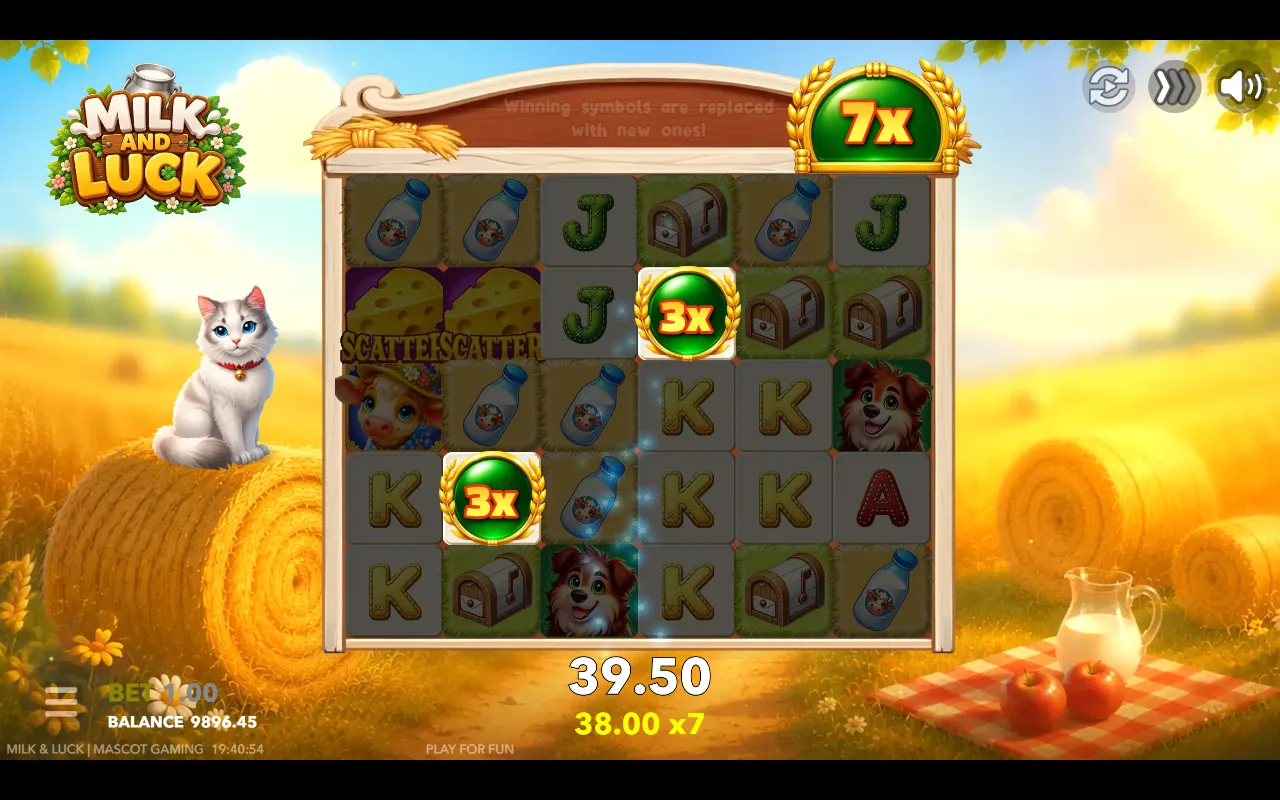
Milk and Luck free spins board with two x3 multiplier orbs and a 7x total multiplier applied to a 38.00 win
One for the start of the round, three for each orb still on screen: the meter reads 7x and lays it over the whole chain at once. Nowhere else in the game does a multiplier survive past the spin that made it.

Two prices for the same twelve spins

The buy menu sells the same twelve spins at two prices. 100x the bet gets twelve spins with the meter at 1x; 250x gets the same twelve spins with the meter already at 6x, 7x or 8x, drawn at random. Nothing else differs, so the dearer card buys a head start rather than a different round; a cheap round that collects two 3x orbs is standing where the expensive one begins. Both prices move with the bet.

Both are played at a lower return. The game states two RTPs side by side, 95.80% for the base game and 93.94% for anything reached through the Risk game or a purchase, so buying costs nearly two points of return before the first spin lands. The drop is not hidden; 93.94% sits two lines under 95.80% in the game's own info panel, with the decision left to you.

Milk and Luck buy feature menu offering twelve free spins for 100.00 or for 250.00 with a random x6 to x8 starting multiplier
The same twelve spins at two prices. The 250x card buys no extra spins - only a meter that opens somewhere between x6 and x8 instead of at x1.

Risk Mines, a bear trap under the hay

Every win, base game or bonus, 0.20 included, lights a RISK button beside the spin button. Press it and the win goes onto a grid of thirty hay bales. Each bale hides a multiplier, an arrow up to the next level, or a steel bear trap. A multiplier multiplies what you carried in, the arrow moves you to a level with bigger multipliers, the trap takes everything; you can collect at any point before it. Level 1 offers 1x, 2x and 3x. The whole thing is capped at 3,000x the bet.

We risked 0.20. The first bale gave a 2x and the win became 0.40; the second bale was the trap - the 0.40 was gone. In seven further spins the game never offered us another go.

It is a minesweeper gamble, which fits a game whose typical win is 0.20 and whose typical answer to that is a shrug. But two things limit it. It does not run under autoplay, so anyone spinning on auto never sees it. And it multiplies the win in front of you, which on this game is usually a fraction of the stake; doubling 0.20 is not a plan. The 3,000x ceiling is only reachable by walking a bonus-sized win into the hay, which takes a different kind of nerve from doubling 0.20.

Milk and Luck Risk Mines grid of thirty hay bales with a legend showing x1, x2 and x3 multipliers, a bear trap and a level-up arrow
Thirty bales, three multipliers, one level-up arrow and a bear trap. Any win at all can be walked in here and climbed towards 3,000x, and the trap ends it with nothing.

The farm and the one thing on it that bites

It is a picture-book dairy farm, drawn with more care than a paytable that stops at 85x deserves. A cow in a straw hat, a white ragdoll cat, a red collie, then a mailbox and a milk bottle for the middle of the table, then royals stitched out of fabric at the bottom. The tiles behind the animals are tinted, so the board reads as patchwork rather than a wall of cream, which matters on a game where you will stare at a great many dead boards. The white cat on the fence beside the reels is scenery; she is also the second-best symbol on the grid. When the free spins start the meadow turns to a mown field at golden hour; she gets up from the fence and settles on a hay bale. Nobody had to do that.

The one image that does not belong to this world is the losing symbol in the Risk game, a steel-jawed animal trap under the straw. Every other inch of the game is milk and daisies; Risk Mines, the one feature that takes money away, is the only place it shows teeth.

Pros and cons

For

  • The free-spins meter is simple, honest maths: orbs add, the total carries, nothing resets until the round ends. One 7x chain turned a 100.00 buy into 268.90.
  • Risk Mines is a gamble with a decision in it, a level ladder and a 3,000x cap, rather than a red-or-black coin flip.
  • The retrigger drops to three scatters inside the bonus, when four are needed to get in.
  • Both returns are stated, including the 93.94% the buy button costs you.

Against

  • 95.80% is low for this board; Gates of Olympus 2500 runs at 96.52% on the same shape.
  • Twelve of a symbol pays the same as thirty, so the one thing a cascading grid can build, a full screen, is worth nothing extra.
  • Most base-game wins are under the stake: 0.20 for eight J's, 0.30 for eight Q's, with the full light show for each.
  • Only 3x orbs turned up in our session, so the meter climbs slowly unless you pay 250x to start it at 6x or more.
  • Risk Mines is switched off under autoplay.

Our 100.00 buy came back 268.90; everything beyond 1.50 arrived on the eighth spin, where two 3x orbs met a 38.00 chain. That is the game in a sentence: a high-volatility tumbler whose base game is mostly a place to wait, with a bonus that lives or dies on whether the orbs turn up while a chain is running. The 95.80% return is the price of the 27,000x sign; the 93.94% behind the buy button is the price of skipping the wait. The player this is for pays 250x for a meter that starts at 6x, wants that sign to mean something, and has the nerve to walk the result into the hay bales afterwards.

Played and reviewed by the SlotsReach editorial team · Published 6 Sept 2026