Sunnydaze Asylum Slot Review
by Pragmatic PlayReleased Jul 27, 2026
Specifications
| Game Type | Slots |
|---|---|
| RTP | 96.53% |
| RTP Range | 94.51 / 95.53 / 96.53 |
| Volatility | Medium |
| Max Win | 10,000x |
| Grid | 5x5 |
| Min Bet | $0.2 |
| Max Bet | $720 |
| Hit Freq | 27.93% |
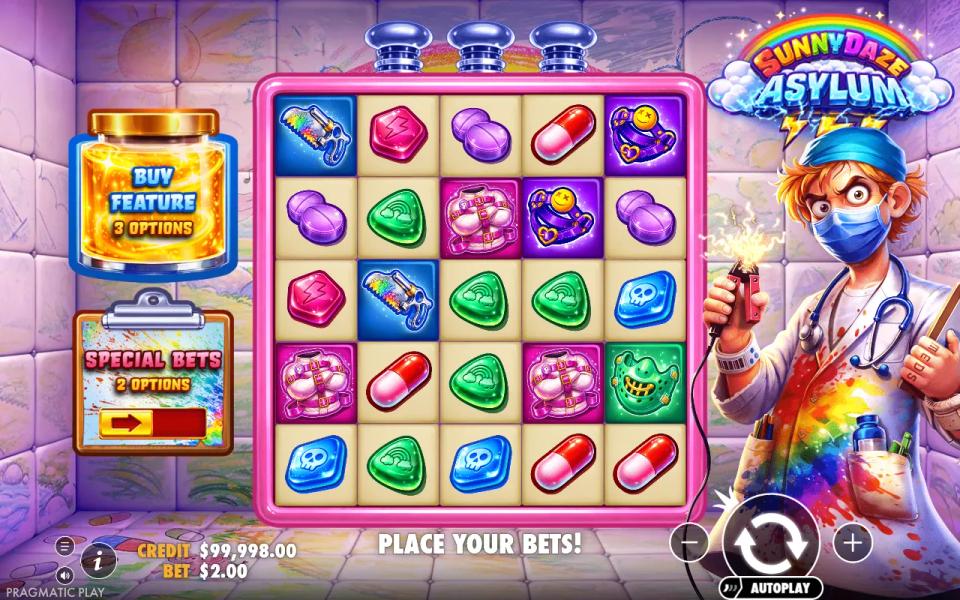
Pragmatic Play has built a tumble-and-multiplier slot inside a padded cell, scrawled crayon drawings on the walls so the room reads as a nursery, and left a masked doctor in the corner holding a sparking electroshock paddle. Sunnydaze Asylum came out on 27 July 2026: five reels of five rows, 3,125 ways, wins from the left, and every win clearing off the board so the symbols above can drop in. The best symbol pays 4x for a full line of five. The sign over the door says 10,000x. Everything in between is carried by one symbol, a multicoloured disc that lands once per tumble chain and lights up silver and gold multipliers over the reels, silvers adding together and golds multiplying the sum.
The RTP is 96.53%, the volatility medium by the game's own badge, the bet anywhere from $0.20 to $720. We played ten base spins at $2.00, eight of which paid nothing, then bought the free spins for $200 and got $173.60 back. Most of what follows is about that round, because ten base spins produced one tumble chain, one $2.00 win, and nothing else worth watching.
The base game is a refund machine
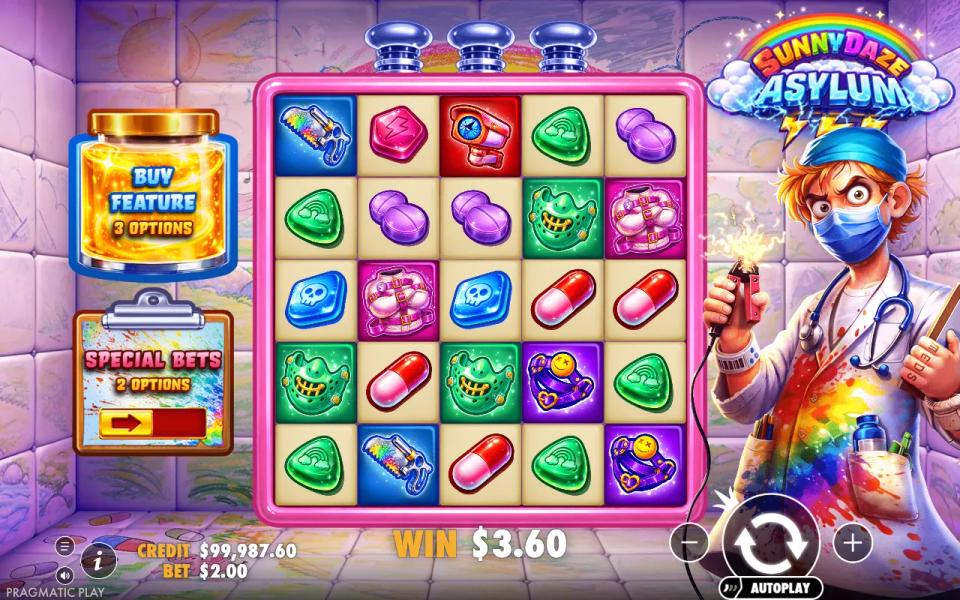
Ten symbols at three counts each make thirty prices on the paytable; the largest of the thirty is $8.00 on a $2.00 bet. Three of a kind never beats the stake: the pink straitjacket, the top symbol, returns exactly $2.00 on a $2.00 bet for three; the other nine all return less than you put in. Four of a kind beats the stake on two of the ten. The five pills at the bottom of the table pay between $0.60 and $1.00 for a full line; two pairs of them are identical at every count.
The wild is a jar of pills that lands only on reels two, three and four. Wins have to start on reel one, so the wild can stretch a combination but can never open one - a wild sitting between two matching symbols on reels three and four is worth nothing at all. The scatter is a jar of golden liquid - it pays nothing either. Three of them open the free spins; two of them do nothing whatsoever, no coins, no meter, no consolation.
Our ten spins were the shape the hit rate predicts. One in 3.58 base spins pays something on average; we saw two: a $3.60 chain that started with a three-camera win and a five-skull win for $0.80 each, tumbled once for another $2.00, then stopped; and a single $2.00. The other eight were full boards of pills that did not touch. A dead board here means no tumble, no disc, no lit canister - eight spins out of ten with nothing on screen to watch.
Silver adds, gold multiplies, nothing carries over
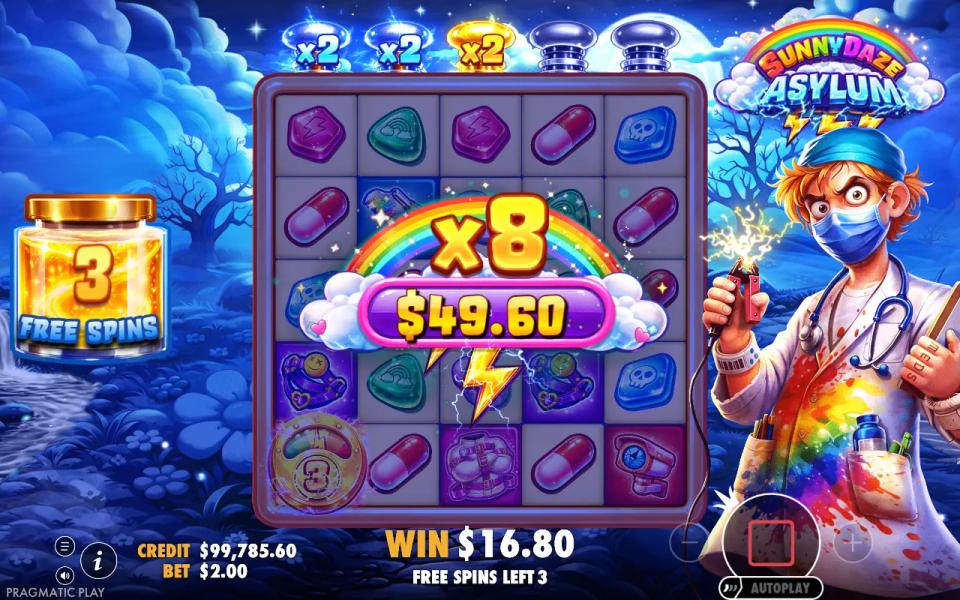
The multicoloured disc that carries the game from 4x to 10,000x is printed with a number, which is not a multiplier at all. It is a count: how many of the canisters above the reels will light up once the chain has finished. In the base game that is one, two or three. Each lit canister is either silver or gold. Silvers run from x2 to x100 and are simply added together. Golds run from x2 to x10; each one multiplies the silver total in turn. Two silver x2 and one gold x2 is not x6; it is 2 plus 2, doubled, which is x8. Then the whole chain's win is multiplied by the result.
Two things about that decide how the game plays. First, the multiplier applies to the chain that produced it - then it is gone. There is no meter climbing through the round, nothing held over to the next spin. Ten free spins are ten separate attempts rather than one building run. Second, the multiplier is applied to the chain's total at the end, so a disc that lands on a board paying pennies multiplies pennies. We watched a x2 arrive on a chain worth $0.40. And the disc lands once per chain at most, so a small total is never rescued by a second one.
That is what reaching the top prize actually takes. The paytable cannot get you there; 4x for a full line means a big chain on its own is a few dollars at this stake. The 10,000x lives in the canisters: a large silver base - the x50 and x100 silvers exist - with more than one gold stacked on top of it, all landing on a chain that was already worth something. The game quotes the odds itself, one round in 3,650,968 for the maximum, one in 866,326 for anything over 5,000x, and one in 40,469 for anything over 1,000x. Hit 10,000x on a round total and the game ends it there: win paid, remaining free spins forfeited.
The free spins, and what $200 bought
Three or more scatters, or a $200 purchase, open ten free spins with five canisters over the reels instead of three. The count of scatters that triggered the round does not change the spin count; it sets the floor on how many canisters a disc lights. Three scatters can reveal anywhere from one to five; four guarantee at least three; five always light all five. Retriggers are cheaper than the trigger: two scatters during the round add three spins, three add five, four add ten, five add fifteen.
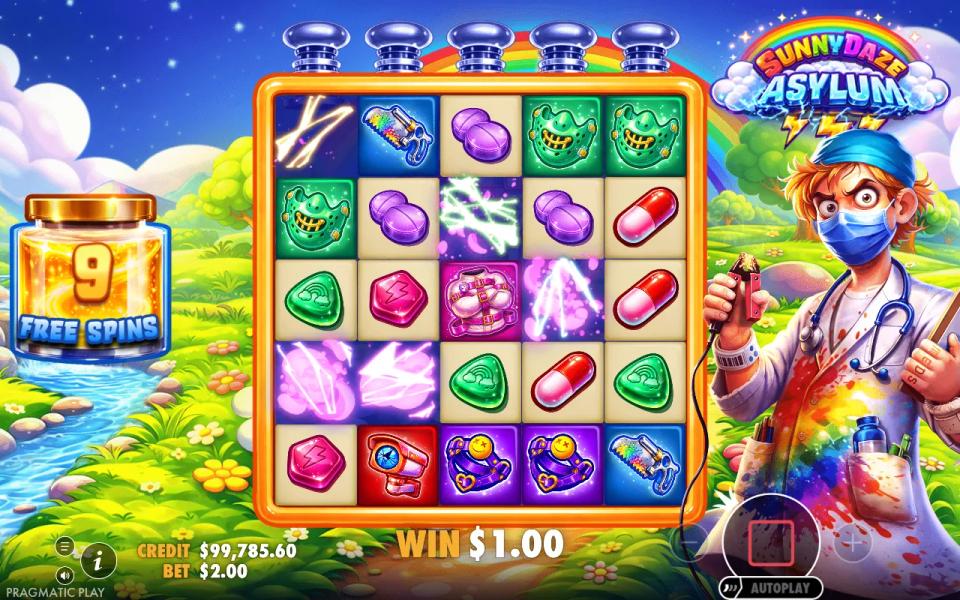
We bought the standard round at 100x, $200 at our $2.00 bet. The first spin paid $1.00. A two-scatter retrigger turned ten spins into thirteen. Most of what followed came in pieces of three to seven dollars, chains of pills clearing and refilling with the odd small multiplier on top. Then one spin, three from the end, landed the silver-silver-gold combination above and paid $49.60. That one spin was more than a quarter of the round. The closing card read $173.60 in 13 free spins; the balance went from $99,985.60 before the purchase to $99,959.20 after it. A bought round coming back under its price is nothing unusual; the shape of this one is the thing to know - $3 to $7 at a time, then one $49.60 chain, nothing carried between them.
Three buys and two antes - the cheap ante is the worst deal
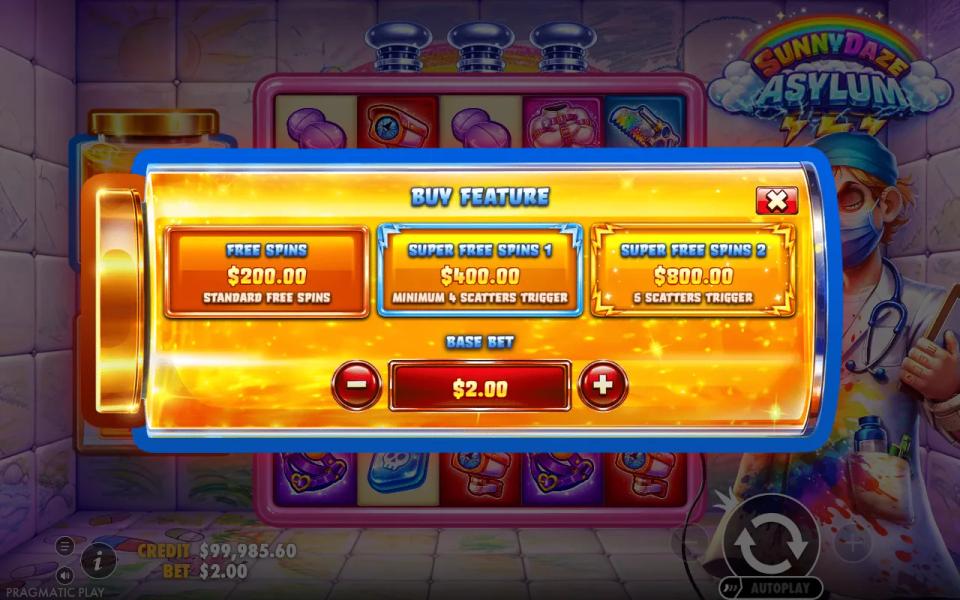
The buy menu has three prices, $200, $400, and $800 at a $2.00 bet; they differ only in how many scatters land on the triggering spin. Free Spins at 100x guarantees three to five. Super Free Spins 1 at 200x guarantees four or five. Super Free Spins 2 at 400x guarantees five, which means every disc in the round lights all five canisters. So the expensive tiers buy certainty about the multiplier floor, not access to anything the cheap one is locked out of: the 100x buy can land five scatters by chance - if it does, it is the 400x round for a quarter of the price. The RTPs are 96.51% for the 100x, 96.49% for the 200x, and 96.51% for the 400x, so the middle tier is the one to avoid on paper.
The special bets are two ante levels bought per spin. Ante Bet 1 costs 1.5x the stake and doubles the chance of triggering naturally, with the RTP dropping to 96.48%. Ante Bet 2 costs 3x and makes the trigger five times more likely, with the RTP staying at 96.53%. Paying less buys you proportionally less chance and a worse return - the opposite of how these ladders usually read. Ante Bet 2 is also what takes the maximum stake to $720; at normal play the top bet is $240. Neither ante changes the paytable, the multiplier ranges or the ceiling. A natural trigger comes round once in 299 spins unassisted, so the antes are for anyone who wants the meadow without the $200 outlay - $3.00 or $6.00 a spin instead of one lump.
The cell, the doctor and the meadow
The theme is cheerful menace, done with more care than a paytable that stops at $8.00. The cell is lilac and white, padded; someone has drawn a sun, a tree, a singing bird, and a green field on the walls in crayon, so it reads as a nursery until you notice the padding. The symbols are the pharmacy and the restraint cupboard: capsules and tablets at the bottom of the table, then a mouth gag, a security camera, a bone saw, a grinning face mask and a straitjacket at the top. The doctor watching from the right is masked, wide-eyed and spattered in rainbow paint with a few darker red splashes, holding a sparking electroshock paddle like a lighter. Nothing about him suggests care.
Then the free spins let the patient out. The cell is gone; the board sits over a sunlit meadow with a stream and a rainbow; the trigger card brings out a unicorn cow, a pill bottle with wings, a pink elephant, and butterflies, all in the same crayon hand as the cell walls. It is the neatest idea in the game: the bonus round is the medication working - the cell comes back when the spins run out. Among the cartoon-horror games on the site its nearest neighbour is Demonic Dolls - another 5x5 at 10,000x and medium volatility, though that one is a cluster game hitting on 39.80% of spins against 27.93% here.
Pros and cons
For it
- The silver-and-gold arithmetic is genuinely clever, legible on screen too: you can see exactly why x2, x2 and x2 made x8 and paid $49.60.
- The 100x buy can land the same five-scatter round the 400x buy guarantees, so the cheap purchase is not locked out of anything.
- Retriggers start at two scatters, which turned our ten spins into thirteen.
- The hallucination-as-bonus idea gives the scene change a reason; the crayon nursery on a cell wall is a better joke than most asylum slots manage.
Against it
- Eight of ten base spins paid nothing; the two that did returned $3.60 and $2.00 at a $2.00 stake. There is nothing to look at between features.
- No multiplier survives the chain that made it, so the free spins never build; the $200 round came back $173.60 in pieces with one spike.
- The paytable maxes at 4x and three of a kind never beats the stake, so a full-screen chain with no disc on it is small change.
- Ante Bet 1 costs 1.5x for twice the chance and a lower RTP, while Ante Bet 2 costs 3x for five times the chance at full RTP - the cheaper option is worse on both counts.
Sunnydaze Asylum's $200 round came back $173.60; $49.60 of that was one silver-silver-gold chain, three spins from the end, on a board that had been paying $3 to $7 at a time. That is the game in one round: long stretches of pills clearing for a few dollars, then one chain the canisters decide to take seriously. It is a 10,000x ceiling on a medium-volatility badge. The badge is honest: the hit rate of 27.93% is the same figure as Gates of Olympus 2500, which sits at high volatility with a 25,000x top on the same studio's scatter-pays board. Sunnydaze Asylum gives up the bigger ceiling for a round that resets every chain - that is the trade between them. Set against Moon Rush, the studio's other medium-volatility tumble game, out on 1 September, it has twice the ceiling at 10,000x against 5,000x and a much better reason to exist.
Buy in once at 100x, watch five canisters over a meadow, and find out whether a gold ever lands on a real silver base: that is the whole offer, $200 at a $2.00 bet; the base game, eight dead boards in ten, is only the corridor to it.
Played and reviewed by the SlotsReach editorial team · Published 6 Sept 2026