SlotsReach

3 Flaming Clovers Slot Review

by EvoplayReleased Sep 17, 2026

Evoplay repaints its familiar three-pots hold-and-win mechanic with fire and classic fruit symbols. The base game pays next to nothing, but the independent dual grids and heavy-lifting collector modifiers make the bonus round worth the wait.

Demo player curtain

Specifications

Game TypeSlots
RTP96.31%
VolatilityHigh
Max Win7,324x
Grid5x3
Paylines20 fixed paylines
Min Bet$0.1
Max Bet$10000
Themes
Features

All the money lives behind one door

Evoplay took its familiar three-pots bonus and repainted it as Irish luck on fire. You get a 5x3 grid with 20 fixed paylines, an RTP of 96.31%, and a ceiling of 7,324x your stake. Almost none of that max win is reachable from the reels themselves. Everything between bonus rounds is time spent getting to the next one, and the clovers that decide when it opens spend most of their time taunting you.

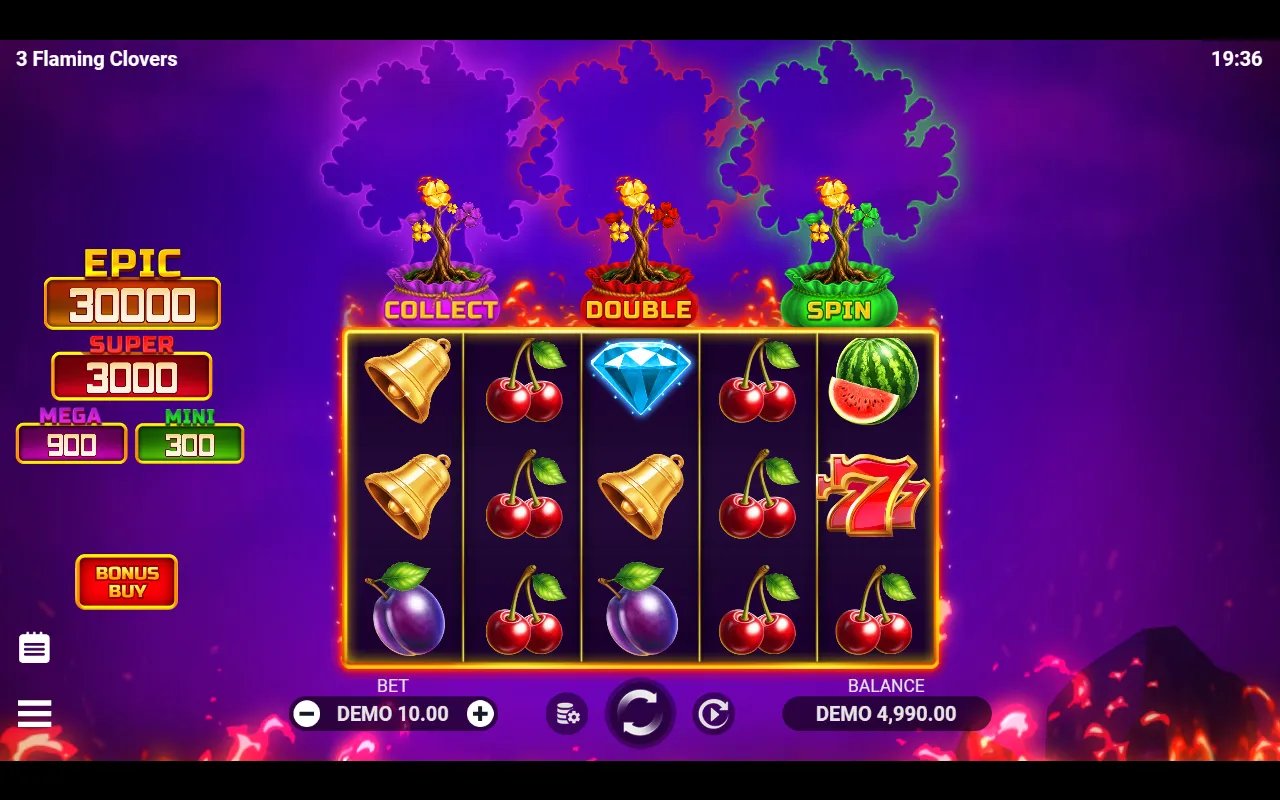
3 Flaming Clovers 5x3 reels of fruit, bells and red sevens under the Collect, Double and Spin clover trees, with the EPIC, SUPER, MEGA and MINI jackpot plates down the left edge
The whole game on one screen: three booster trees over the grid, four fixed jackpots down the side, and a paytable underneath them that tops out at 100x.

What the clovers are worth

Bonus clovers land in the base game with a cash figure stamped right across them. They come in purple, red, or green, carrying values from 1x up to 15x your stake, or a jackpot face. At a ten-unit bet, you might see a clover reading 150 sitting right on the middle reel.

Except that they pay absolutely nothing in the base game. Clover values only pay out inside the bonus round. Unless that exact spin happens to trigger the feature, the cash you are looking at vanishes when the reels turn again - and the clovers land often enough that watching the money leave becomes the base game's main event.

The base game is hard to read because it uses no collection threshold. A single clover carries a chance of opening the round, and three landing together carry no guarantee. You cannot count your way to a trigger, and a board with two clovers is not obviously better news than a board with one.

Meanwhile, the regular symbols feel completely inert. The top blue diamond pays 100x for five, while the fruit symbols bottom out at 3x. Against a 7,324x ceiling, that standard paytable is just decoration, and whole stretches of spins can pass without a single winning line.

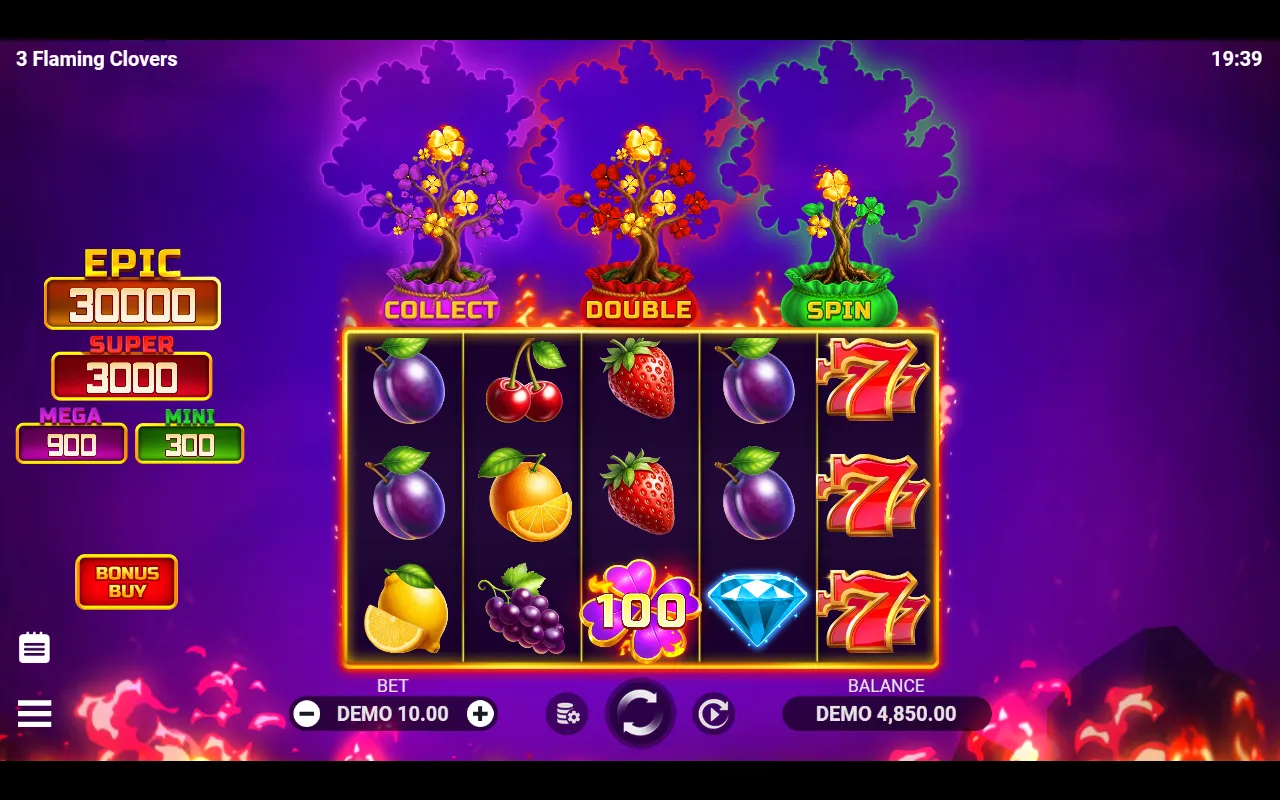
A bonus clover stamped 100 on the middle reel beside three stacked red sevens on the last reel of the 5x3 grid
A clover stamped 100, ten times the stake, next to three stacked wilds. Neither is worth anything: clover values only pay inside the bonus, and wilds never land on reel one, so they can extend a line but never start one.

The hold-and-win round and its three trees

When the clovers finally let you in, the game shifts to a familiar hold-and-win shape. Triggering clovers turn gold and lock in place, and you get three spins on a grid holding only blanks and gold clovers. Every new drop resets the counter back to three, and the round ends when the spins run out or all fifteen positions are full.

The colour of the triggering clover decides which of the three boosters hanging above the grid wakes up. The purple one is a collector: it drops into an empty cell, sucks up the value of every clover on its grid and becomes an ordinary clover holding the lot. The green one adds a spin, so the counter starts and resets at four instead of three. The red one triggers the Double Game.

Two stacked bonus grids of gold clovers, the upper counting three spins and the lower counting four, with all three booster pots lit above
All three boosters live at once. The upper grid opens on three spins and the lower on four, because Extra Spin applies to one grid and not to the other.

Two grids running on separate clocks

The red Double Game booster is the real reason to play. It stacks a second bonus grid above the first and seeds it with copies of whatever the bottom grid is holding. From there, the two boards run completely independently.

They have separate spin counters and separate endings. Watching them come apart is genuinely good. One grid freezes under the word COMPLETED with half its cells still empty while the other carries on spinning above it, sometimes outliving its neighbour by several spins. At the end, both totals are simply added together.

The upper bonus grid marked completed with empty cells still on it while the lower grid takes another spin
One grid has stopped with gaps still in it while the other keeps going. Filling all fifteen cells is the only route to the EPIC jackpot, so a grid that stalls early takes that route with it.

The jackpots and the ceiling

Four fixed jackpots sit down the left edge: EPIC at 3,000x, SUPER at 300x, MEGA at 90x and MINI at 30x. These are flat multiples of your stake, not progressives, so the numbers only move when you change your bet. The MINI, MEGA and SUPER prizes ride on clover faces like any other cash value, arriving exactly the same way.

The 3,000x EPIC prize is different because it is not a symbol at all. You only get it by filling every one of the fifteen positions on a grid. That explains where the game's massive ceiling comes from.

Double Game gives you two grids, and both can pay an EPIC. Two filled grids mean 6,000x, which is most of the 7,324x maximum. The top prize requires the red clover and two totally full grids in the exact same round.

Two ways into the bonus

You can buy straight into the round two ways. Paying 67x your stake gets you the bonus with one to three random boosters. Handing over 121x gets you all three guaranteed.

The returns run backward here. The cheap buy is set at 96.54% and the expensive one at 95.79%, against a base game of 96.31%. Nearly doubling your price buys you a worse return. The extra money pays for certainty rather than value, and the expensive option sits first in line on the left side of the shop.

The 121x buy opens both grids with all three boosters live, and the collector cells are the ones to watch: they climb well past the ordinary clover values of 1 to 15, and they can end up carrying most of the round.

Sticky gold clovers held across two bonus grids, each grid showing its own running total above it
Each grid keeps its own total and the two are added at the close. The collected cell is where the value concentrates: ordinary clovers land on 1 to 15, and the collector ends up holding the sum of them.

Fruit machine symbols under an Irish sign

The artwork sets a purple mountain night over a bank of lava, but the fire is just atmosphere. Nothing actually burns or spreads across the board. The three clover trees over the grid light up when active and turn into pots of gold in the bonus, which is tidy signposting.

Under the trees, the symbols have nothing Irish about them. Plums, cherries, watermelons, bells, a BAR plaque and red sevens make up the board. It is stock fruit-machine furniture with a shamrock hung over the door.

The three pots, again

This is the same bonus round Evoplay has shipped several times before, in games like Imperial Relics and Patrick's Club, and there is a fruit-themed one in the range already. Three boosters attached to three coloured symbols, a hold-and-win, four jackpot tiers: the machinery is the same each time and only the costume changes. The mechanic is good. But if you have played one of the siblings, you have played the interesting part of this one.

A bought round leans on the collector cells for most of whatever it pays. That is the game in one line: the money is all in the bonus, the bonus is mostly the collector, and the base game exists to sell you the buy.

Double Game is the part worth paying for and the only route to the top prize, which makes the 67x ticket awkward. It has the better return, and it might not hand you the second grid you came for. If you want two grids you have to accept the worst RTP in the game.

Anyone who likes a hold-and-win where the collector does the heavy lifting gets a clean version of it for 67x, provided they can sit through the dead spins in between.

Played and reviewed by the SlotsReach editorial team · Published 3 Sept 2026 · Updated 4 Sept 2026