SlotsReach

Outlaw Rails: Hold & Win Slot Review

by OctoplayReleased Sep 5, 2026

Octoplay's train-robbery hold-and-win, where wagons worth 1x to 10x and locomotives worth up to 500x sit on the reels paying nothing until an Outlaw Collector lands on reel 3 to take them. A second collector copies everything that lands after her, and that was the whole difference between a 100x buy coming back at 60x and at 99x.

Demo player curtain

Specifications

Game TypeSlots
RTP95.7%
VolatilityHigh
Max Win5,300x
Grid5x3
Paylines10 fixed paylines
Min Bet$0.1
Max Bet$150
Themes
Features

Octoplay has made a hold-and-win in which the money is on the reels almost all the time and almost never yours. Wagons stamped with stake multiples and locomotives carrying jackpots land on nearly every spin of Outlaw Rails: Hold & Win; not one of them pays unless an Outlaw Collector happens to stop on the middle reel at the same moment. That single rule runs the base game and the bonus alike. Everything else is scenery.

It is a 5x3 with ten fixed lines, out in September 2026, returning 95.70% under a ceiling of 5,300x that only the jackpot ladder can reach. We bought the Hold & Win twice; neither buy got its money back, which is roughly what the base spins and their unpaid wagons had led us to expect.

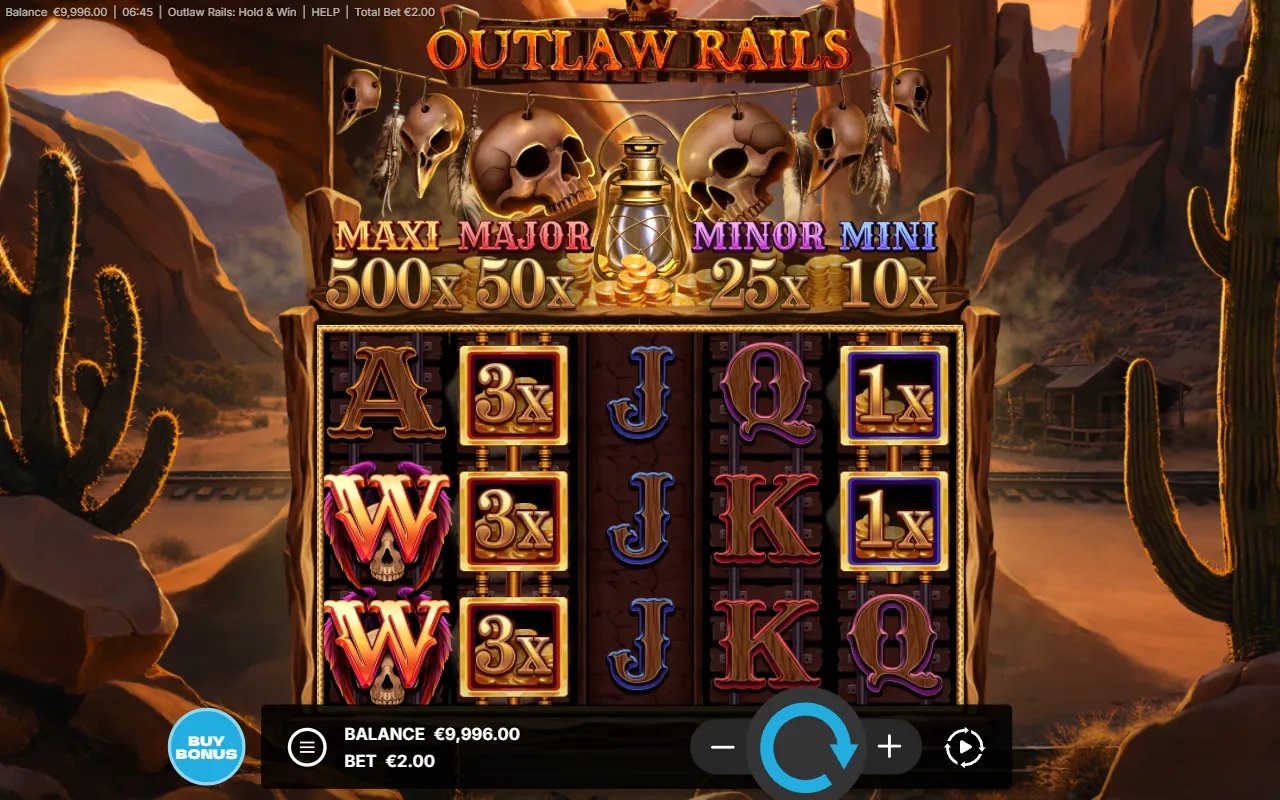
Outlaw Rails reels showing five prize wagons across the board with no Outlaw Collector on reel three
Five prize wagons on one spin. Reel 3 came up empty, so not one of them pays.

The trains pay only when an outlaw is on the board

Four trains, four colours, each owning a reel: gold on the first, red on the second, purple on the fourth, blue on the fifth. Their wagons are printed with a stake multiple - 1x to 3x on the blue train, up to 10x on the gold - and each locomotive stands two cells tall and carries a jackpot from the ladder above the reels, Mini at 10x through Maxi at 500x. None of it counts as a line win. A wagon is worth its printed number only on a spin where an Outlaw Collector is also standing on the board; the collector can only ever land on reel three. The wild will not stand in for a wagon or a locomotive either, so nothing else in the game can rescue a prize symbol from a spin with no outlaw on it.

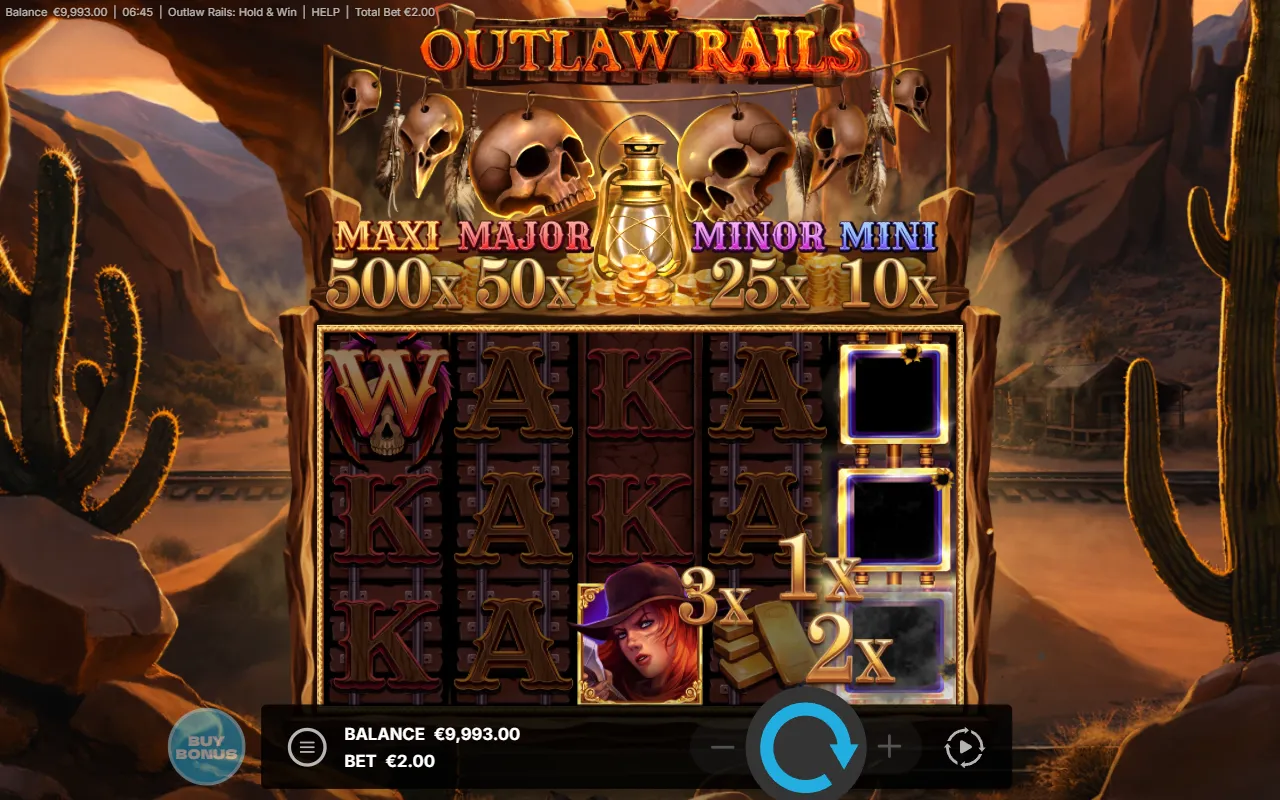
That makes the base game a strange place to sit. Our second spin dropped five wagons at once, three of them red and stacked down the second reel. The board paid nothing: the reel that decides whether you keep any of it came up jacks. Two spins later an outlaw did stop there and emptied the three blue wagons on the last reel into the win box, 12.00 at a 2.00 stake. Nothing else the base game did came close. Between one outlaw and the next, the ordinary paytable does the paying. It is thin: card letters at the bottom, a sheriff's star, coins, a gold sack and gold bars above them, the best of them worth 30x for a full line and the winged wild 50x for five of its own.

The red-haired Outlaw Collector on reel three of Outlaw Rails collecting three blue prize wagons
The same blue train, one spin later, with the outlaw on reel 3. She adds the three wagons and pays the total - and the Mini locomotive above them, half out of the window, is not hers to take.

Inside the hold & win

Four prize symbols and one outlaw on the same spin open the Hold & Win, or 100x the stake buys it. It is the standard shape - a taller grid, three respins, anything useful landing puts the counter back to three - with two things that separate it from the pile. The outlaw locks on the middle reel and keeps one running total for the whole round, so what you are watching is a single number on a single tile, climbing. And a locomotive landing in here pays its jackpot and then shuts its reel for the rest of the round; four shut reels end it, which is the one ending that is not the board going quiet.

Nothing is paid while it runs. The win box reads zero on every respin while the outlaw's number climbs; the whole total lands in one piece when the round closes. Our first buy ran fifteen spins that way, the number climbing to 60x and then sitting there through the last two; by the time the payout came we already knew what it would be: less than the round had cost. Watching it is oddly calm for a jackpot game: two minutes of a number ticking upward, then the payout, then the canyon again.

The second round we bought nearly died at birth. The trigger board handed the outlaw 9x. Two blank respins followed, the counter down to its last spin, the total not moving. Then the third one filled the board with wagons and she stood at 41x. Everything after that was collecting change, but it was the one spin that made the round.

A second outlaw can land while the first is still there; then there are two totals. On the eighth spin of that round one did, carrying nothing; from that point every wagon was counted twice, once into each of them. The second one finished at 19x. The round paid the two totals added together, 99x against the 100x buy - the closest this game came to giving us our money back.

The Outlaw Rails hold and win round closing on a 60x total after fifteen respins
Fifteen respins read 0.00 in the win box, then this. The round banks nothing as it goes, so the only number that ever appears is the last one.

What 5,300x takes

The ladder above the reels is printed in multiples rather than money, 500x down to 10x; it means it: the Mini paid exactly ten times the stake at both stakes we bought at. There is no progressive pot here and no currency figure creeping upward to suggest one.

Reaching the ceiling means the Maxi. The gold locomotive on the first reel is 500x on its own, while the wagons never exceed 10x apiece, so a single outlaw adding wagons all round gets nowhere near - ours peaked at 80x. The distance to 5,300x is covered by several outlaws counting the same board at once, with the male one among them: he lands at most once a spin and triples whatever his total holds. We did not see him in either round we bought, so the tripling is the one part of the design we are describing without having watched it.

Octoplay's ceilings usually sit around 5,000x, so 5,300x is the studio's normal rather than a headline. The game itself words it as its best win achieved rather than a hard limit. The same studio has run this collector idea several times this year under different hats; it ships fast. 2 Lucky Fellas: Hold & Win came out the week before and runs the same mechanic to 3,810x; Most Wanted: Hold & Win, the studio's earlier outlaw game, stops at 4,012x. Neither of those is the train most people will be thinking of. Anyone arriving from Money Train 5 and its 100,000x is in a different building altogether.

Two Outlaw Collectors on the Outlaw Rails bonus grid carrying separate running totals
Two outlaws, two totals, and every wagon that lands from here goes into both. This is the only thing that separated our second bought round from our first.

The buy and the two extra chance options

The buy menu has three cards, of which only one is a purchase. HOLD & WIN costs 100x the stake, a flat price at every stake we checked; it opens on the same intro card a natural trigger would and runs at 95.85%, the best return the game offers. The other two are not buys at all. Hold & Win Chance 2x and Chance 5x are odds boosters charged on every spin: 1.5x the stake buys double the chance of the feature, 3x the stake buys five times the chance. Neither adds a symbol, changes the paytable or raises the ceiling.

The pricing on those two is quietly upside down. The 2x option returns 95.78%; the 5x option, at twice the price, returns 95.76%. Both beat the base game's 95.70% and both lose to simply buying the round; paying more for the chance buys a slightly worse rung. We priced them and left them alone.

The Outlaw Rails buy menu showing the 100x bonus buy beside the two Extra Chance ante prices
One buy and two odds modifiers, priced at 100x, 1.5x and 3x the stake. The dearer of the two Extra Chances is the one with the lower return.

How it looks

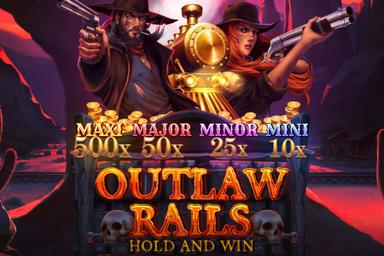
A sunset canyon with a railway running through it, cacti at the edges, a rack of skulls and a brass lamp hung over the jackpot ladder. The reel strips are drawn as track, so every symbol sits on rails, which is a neat way of making the trains feel like they belong on the board instead of being stuck onto it. When the round starts the canyon goes to a red night and the empty cells become rivet targets on dark track, an empty freight train waiting to be loaded; it is the better-looking of the two scenes. Two outlaws serve as the collectors, the red-haired woman being the one you will actually meet. Competent Octoplay house art, nothing more. What stays with you is the ladder in bare multiples, 500x at the top and 10x at the bottom, which tells you the truth about the jackpots before you have spun once.

For and against

For

  • Two outlaws on the board add their totals together; the second one arrives with nothing to lose.
  • The 100x buy runs at 95.85%, above the base game rather than below it.
  • The jackpots are fixed multiples, 10x to 500x, printed that way on the ladder.

Against

  • Wagons and locomotives land constantly and pay nothing without an outlaw on the middle reel.
  • The round pays nothing until it ends; spin after spin of a zero win box is the normal experience of it.
  • The 5x Extra Chance returns less than the 2x one and costs twice as much.

The 100x buy came back under its price both times we pressed it; the round it opens is the only place this game pays anything worth having. The base game is there to be waited through: wagons and locomotives on nearly every spin, the outlaw only now and then, ten thin lines doing the rest. Inside the round the design does have an idea - one number climbing on a locked tile, a second tile doubling the count, a locomotive that pays and then closes its reel - and it is a good one to watch once you have accepted that the total arrives only at the end.

The player this suits is the one who will pay 100x for the chance of two outlaws on the middle reel and will not mind that the win box says zero until the last spin.

Played and reviewed by the SlotsReach editorial team · Published 7 Sept 2026