Pelican Payday Slot Review
by Pragmatic PlayReleased Oct 6, 2026
A 3x5 Pragmatic collect slot that spends most of its time showing you cash it has no way to pay, because the pelican who banks it is locked to the third reel. The free spins let him land anywhere and add a pot that never clears when it pays out.

Specifications
| Game Type | Slots |
|---|---|
| RTP | 96.59% |
| RTP Range | 96.59 / 95.61 / 94.59 |
| Volatility | Low |
| Max Win | 5,000x |
| Grid | 3x5 |
| Paylines | 10 Fixed Paylines (left-to-right) |
| Min Bet | $0.1 |
| Max Bet | $250 |
| Hit Freq | 18.59% |
The illusion of the cash board
Pelican Payday is built around a visual trick that constantly shows you money it has no intention of banking. The math model operates on a restrictive three-by-five portrait grid with ten fixed lines, and because three reels cannot hold four symbols, three-of-a-kind is the absolute ceiling for any line hit. The paytable is brutally top-heavy. Three of the seven regular symbols return less than your stake for a full line, and a fourth only breaks even. Jacks pay a miserable fraction of the bet, while aces hand back exactly what you put in. Even a lucky arrangement lighting up half the board with jacks will barely push past a 1x return. The standard symbols exist entirely to keep the screen busy while you wait for the real economy to land.
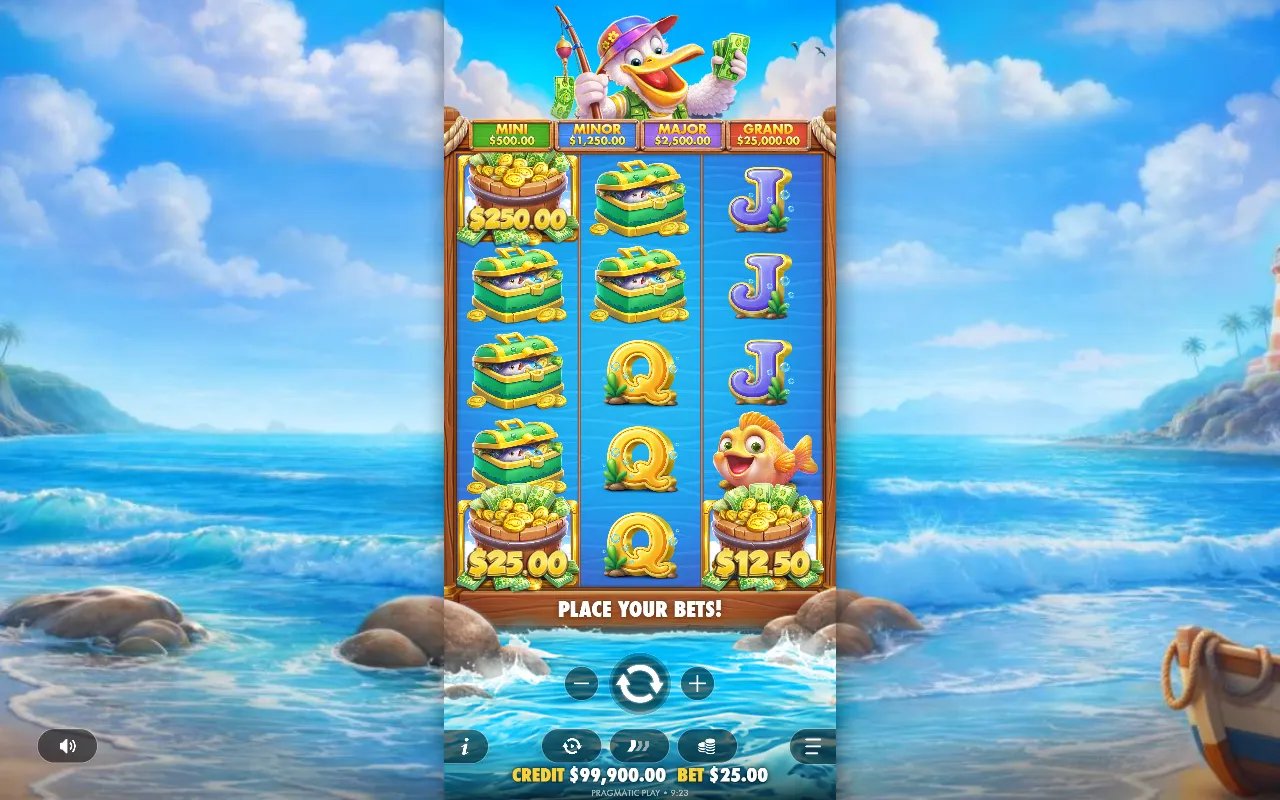
That economy relies entirely on cash baskets carrying values from a fractional 0.5x up to 10x, alongside fixed badges peaking at a 1000x GRAND. The friction here is massive. You will regularly see a board littered with printed cash, a 10x basket on one spin, a 20x MINI badge on another, face-up on the reels, only to watch each spin pay nothing because a goldfish landed where the collect symbol needed to be. In the base game, the collecting pelican is strictly confined to the third reel. There are no wilds to step in and no partial payouts for near misses. You are left staring at dead boards full of uncollected cash, which is the ordinary rhythm of the math model rather than a stroke of bad luck.

Trapped in a low-volatility loop
Low volatility is a rare format for Pragmatic Play, accounting for only a couple dozen titles out of a catalogue pushing eight hundred games. This release, part of the studio's new POP sub-brand, promises a casual ride, but the math often feels sluggish. The hit rate hovers around one in five spins, which is fairly standard but falls short of the rapid-fire frequency you might expect from a low-volatility profile. You also need to watch the RTP. While the top tier sits at a respectable 96.59%, operators can easily toggle this down to the mid-94% range, making a quick check of the rules page mandatory before playing.
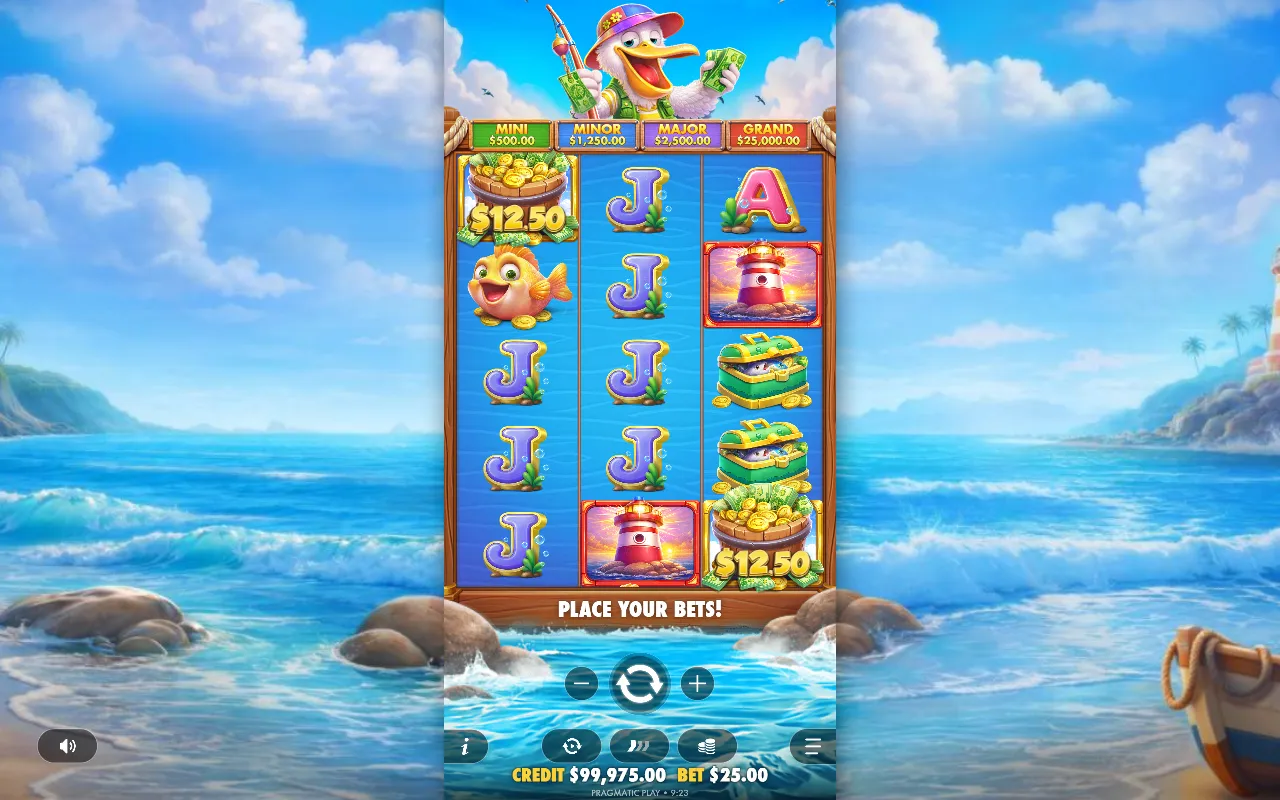
Escaping the base game requires three lighthouses to trigger eight free spins. Lighthouses carry no scatter pay, which is unusual for this developer. Landing just two does absolutely nothing for your balance while blocking valuable grid space that could have held cash baskets. With a trigger frequency of roughly one in 150 spins, you have to grind it out organically. There is no bonus buy menu here, just a bet toggle and a max bet button, forcing you to endure the base game drought if you want to see the game's true potential.

A persistent pot with a missing bird
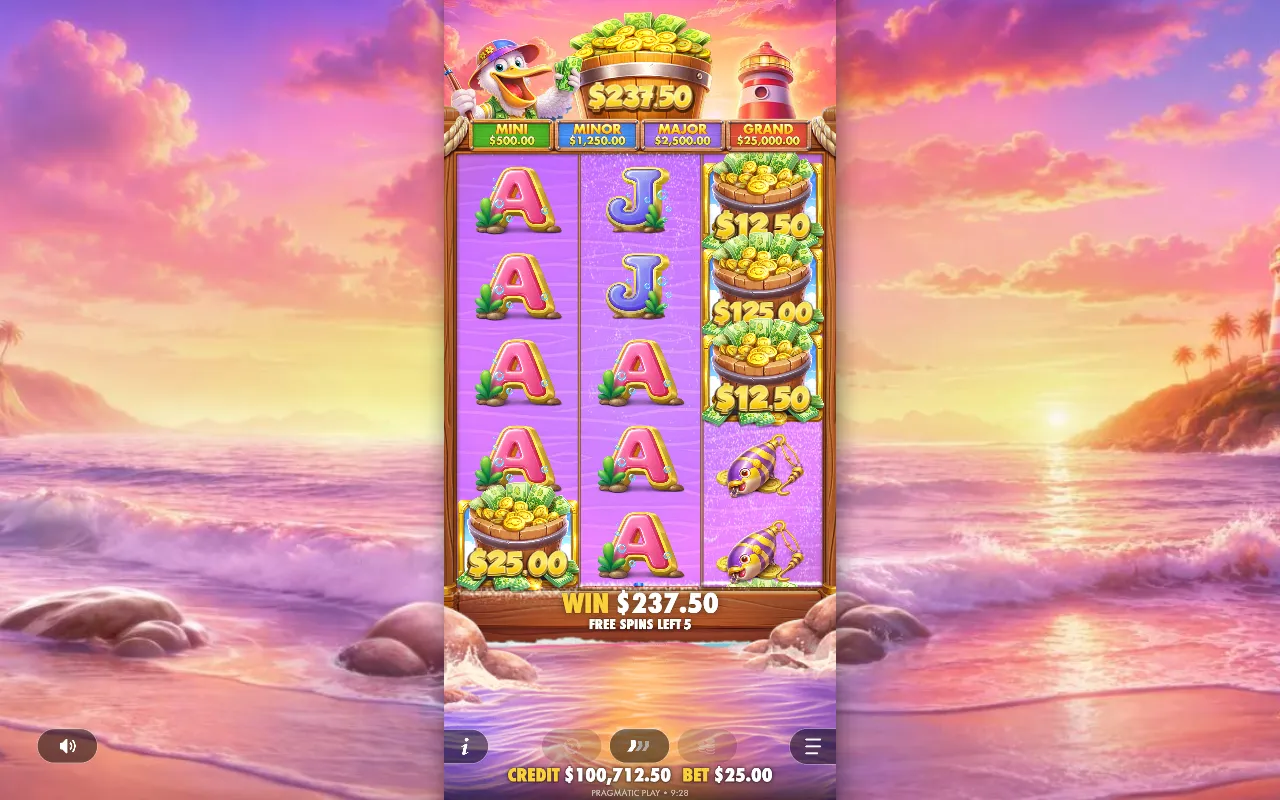
The free spins round finally unshackles the pelican, allowing him to land on any reel. It also introduces a clever compounding mechanic. Any basket on a board that also holds a pelican is swept into a persistent pot above the reels. When a pelican hits, it pays the current value of that pot. Crucially, the pot never clears. If you bank a 10x collect early on, that value sits there. A subsequent pelican landing alongside a 20x MINI badge will pay out the new total, folding the previous collect into the new one.

The bottleneck is that the bird is just as elusive inside the feature as he is outside it. Baskets that land without a pelican add absolutely nothing to the pot. It is entirely possible to watch half your free spins bleed away as dead boards, with the pot frozen exactly where the last collect left it. Retriggers require three more lighthouses for an extra eight spins, and there are no multipliers anywhere in the round. The advertised 5,000x max win is essentially poster material. Reaching it requires a statistical miracle, odds stretching past one in two and a half million, demanding multiple 1000x badges collected in a single round on a tiny fifteen-cell board.

Where the math falls short
Pragmatic has flooded the market with collect mechanics, pushing out over a hundred games in this style. When you stack the numbers, Pelican Payday struggles to justify its restrictions. The studio's own Heartbreakers runs a nearly identical hit rate and the same low-volatility grind, but doubles the ceiling to 10,000x. Deep Sea Frenzy offers a much healthier hit rate pushing past 30% and a 16,000x ceiling at medium volatility. Even looking at older staples, Big Bass Bonanza caps lower at 2,100x but delivers a far more balanced medium-high volatility math model.
Looking outside the studio, Yggdrasil's 3 Piggies of Bank delivers a similar low-volatility collect format with a wider board, a hit rate clearing 25%, and a slightly higher max win. Pelican Payday restricts its core mechanic so heavily in the base game that it creates constant visual frustration. It functions fine for a conservative player looking to stretch a small balance without expecting a massive return, but anyone looking for mechanical efficiency will find the math far too restrictive.

Played and reviewed by the SlotsReach editorial team · Published 8 Sept 2026