SlotsReach

Sugar Loot Spark Slot Review

by GameArtReleased Sep 22, 2026

A 6x5 candy cascader from GameArt whose multiplier tiles add up and then double, to x128 once they stick in the free spins. Its best-paying symbol, a cupcake worth 5x to 50x, only ever lands on a spin that lost.

Demo player curtain

Specifications

Game TypeSlots
RTP96.29%
VolatilityHigh
Max Win15,000x
Grid6x5
Min Bet$0.25
Max Bet$100
Themes
Features

The friction of a weak paytable

GameArt is stepping onto a heavily contested 6x5 grid with Sugar Loot Spark, a scatter-pays cascader slated for a 22 September 2026 release. The math model demands eight matching symbols anywhere in view to trigger a payout, which bursts the winners and cascades new tiles from above. You will not find a single wild to bridge the gaps. The paytable itself is top-heavy and highly restrictive, paying identical amounts for eight and nine of a kind, and again for ten and eleven. Only a cluster of twelve moves the dial.

Because the base candies pay so poorly, generating a meaningful balance shift relies entirely on the multiplier economy. The pink swirl peaks at a 36x payout for twelve or more, but its entry point for eight is just 4x. Down at the bottom, the jelly bean offers a miserable 0.16x for an eight-symbol hit. Most clusters fail to cover the bet, making the base symbols little more than delivery mechanisms for the biscuit multipliers.

Every winning symbol leaves behind a biscuit tile stamped with an x1 multiplier. That tile sits dormant during the cascade that created it. If a subsequent win lands squarely on top of it, the game adds the values of all tiles involved in the cluster, applies them to the payout, and then doubles each tile. Hitting the same square repeatedly pushes it from x2 to x4, up to a cap of x64 in the base game. The friction comes from the reset rule. When a cascade sequence ends in the base game, the board wipes clean. You frequently watch a row of x1s and x2s evaporate before they ever contribute to a win.

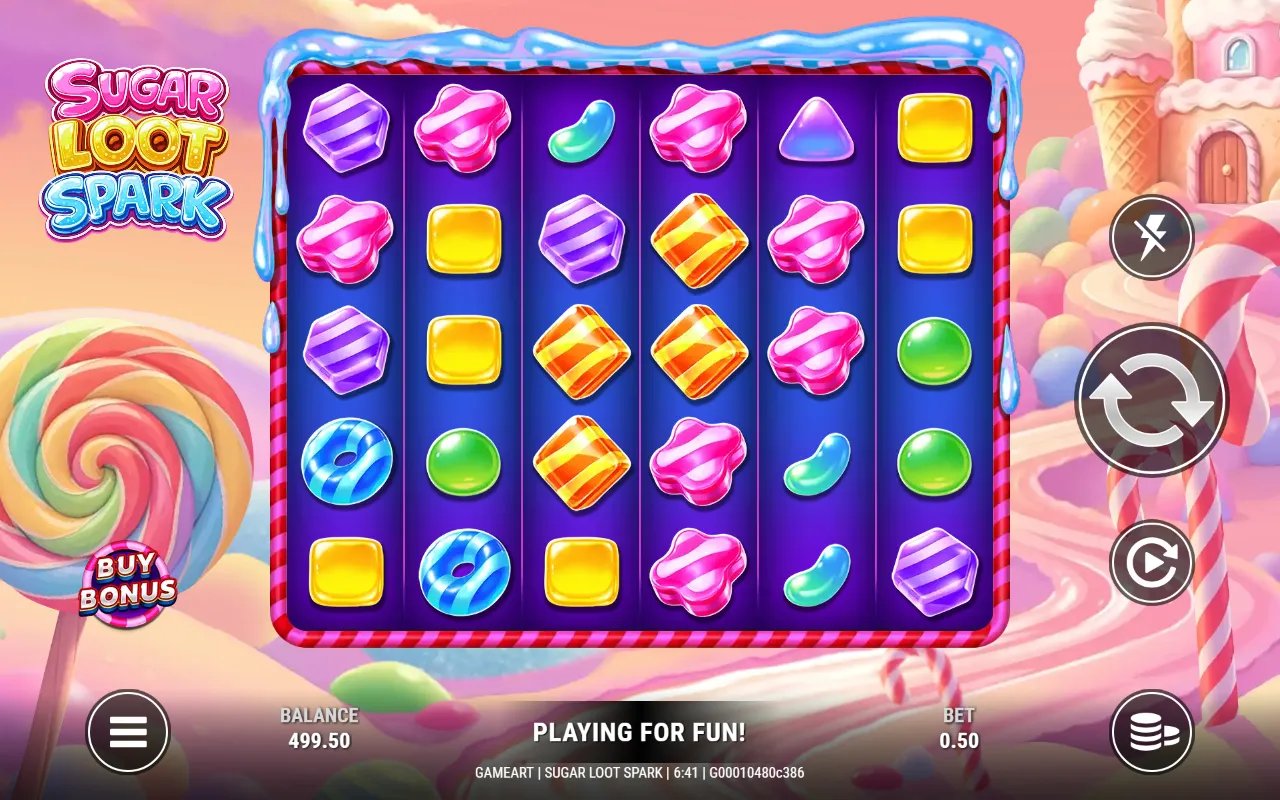
Sugar Loot Spark 6x5 grid showing a full spread of candy symbols with no cluster of eight and nothing paying
A full board of sweets and not one cluster of eight, which is the base game's ordinary state. Nothing substitutes, so a near miss pays exactly what a dead board pays.

Getting paid to lose

The game handles its instant prizes with a strange structural twist. The Sweet Prize Loot, referred to as the Candy Cash Prize in the studio's documentation, is a cupcake symbol printed with values of 5x, 15x, 20x, or 50x. Up to three of these can drop on a single spin, and their values add together to multiply the total bet.

The bizarre reality of this cupcake is that it only lands on a non-winning base game round. You will never see it in the free spins, and you will never see it alongside a paying cluster. GameArt essentially designed the most lucrative symbol in the game to act as a consolation prize. A totally dead board can easily produce a 10x return if two 5x cupcakes drop, which regularly outpays the cascading candy clusters you were actually trying to connect.

The mathematical incentive to buy

Triggering the free spins requires four chocolate bomb scatters. Landing two or three bombs offers zero payout and zero feature access, making them dead weight on the board. Once inside the twelve free spins, three bombs will retrigger an additional three spins with no limit, but the initial entry is strictly gated behind four.

GameArt actively nudges you toward the 90x bonus buy by baking a mathematical advantage into the purchase. The base game operates at a 96.29% return, but buying directly into the feature bumps the RTP to 97.15%. Inside the bonus, the grid shifts to a green night theme and the maximum tile multiplier doubles to x128. More importantly, the tiles stop resetting between spins.

Outcomes on the 90x buy swing wildly based on symbol distribution rather than the number of spins. A feature can easily yield a 113x return if the clusters repeatedly strike the same column, compounding the tiles into a stack of x8s and x4s that multiply anything touching them. Conversely, if the cascades continually target fresh grid squares instead of primed tiles, that exact same 90x cost can result in a dismal 5x return. The entire value of the bonus relies on spatial density, not duration.

Multiplier tiles in the Sugar Loot Spark free spins grown to x8, stuck to their squares across the grid
Multiplier tiles stay where they land and keep doubling, which is the whole argument for paying 90x rather than spinning. A base game round throws these away every spin.

Where it sits against its neighbours

Pushing a 15,000x maximum win requires a heavy multiplier engine, and GameArt claims to have proven this ceiling in a billion simulated rounds. It represents a massive leap for a studio whose 160-game portfolio typically caps around 3,000x, as seen in their recent low-volatility 40 Splendid Sevens release at 96.21%.

When placed against the heavyweights sharing this specific cascade mechanic, Sugar Loot Spark lands right in the middle. Gates of Olympus 2500 runs the same 6x5 scatter-pay format at a 96.52% return for a 25,000x cap. Milk and Luck, releasing on 17 September, offers a 27,000x ceiling at a lower 95.80% RTP.

Players will inevitably compare this to Sugar Rush, which utilizes a 7x7 grid and a 5,000x cap at a 96.50% return. While GameArt provides a much larger max win here, Sugar Rush hits on roughly 34.48% of its spins. Sugar Loot Spark connects only about one in four times, leaning heavily on its persistent free-spin multipliers and that strange, losing-spin cupcake to justify the mathematical drought between payouts.

Played and reviewed by the SlotsReach editorial team · Published 8 Sept 2026