3 Adventures of Alice Hold & Win Slot Review
by Hacksaw GamingReleased Oct 29, 2026
Specifications
| Game Type | Slots |
|---|---|
| RTP | 96.26% |
| RTP Range | 96.26% / 94.30% / 92.32% / 86.29% |
| Volatility | Medium |
| Max Win | 2,500x |
| Grid | 5x3 |
| Paylines | 9 |
| Min Bet | $0.1 |
| Max Bet | $400 |
| Hit Freq | 41.68% |
The factory line
Hacksaw Gaming is a studio players usually associate with massive caps, pushing titles that swing for the fences. But there's a quieter, heavily populated assembly line running in the background. Twenty-two of the Hacksaw Gaming titles in our catalogue at the time of writing are dated to the ninety days around this release, and a very specific template is doing a lot of the heavy lifting. 3 Adventures of Alice Hold & Win is the fourth medium volatility 5x3 hold-and-win we list from them inside six months, after 3 Cursed Chests: Hold & Win, 3 Magic Piggy Banks: Hold & Win and The Jade Path Hold & Win. It's a formula they've settled into, taking a familiar math model and dressing it in whatever theme is next on the schedule.
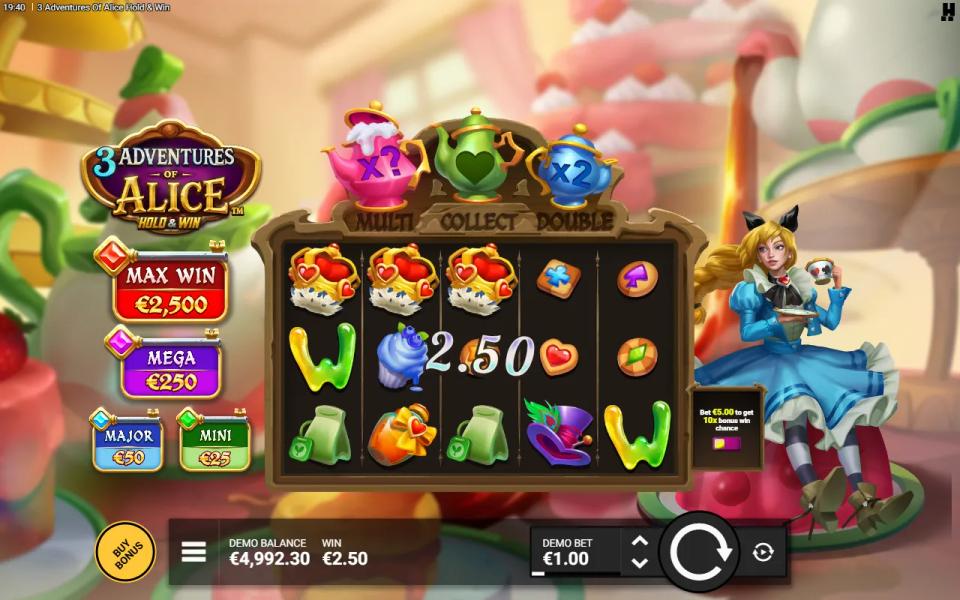
The thematic riff here is a tea party happening on a shelf above the layout. Three teapots, pink, green, and blue, sit up there, watching a grid that acts as a simple holding area. The base game down below feels entirely disconnected from the real action. It's just a mechanism to get you onto that shelf, where the pots decide what a round is actually worth.
The machine underneath the shelf runs at medium volatility across a 5x3 layout with nine lines. The return sits at 96.26%, calculated over ten billion simulated rounds, while the hit rate comes in at a fairly high 41.68%. The maximum bet stretches up to 400, and the maximum win is capped at 2,500x the stake.
Climbing to the shelf
Because the base game exists only to deliver you to the bonus, the paytable is deliberately flat. Five top picture symbols or five wilds pay 10x the bet, and with only nine lines a wild turns up far more often than it finishes anything. The scatter is a teacup, and it carries no value of its own. You only need one to trigger the Tea Party, though up to three can land, bringing their respective colors into the round as sticky symbols.
The Tea Party is a hold-and-win with three lives that refill whenever a coin, a jackpot marker, or a teacup lands. Blank acorns and cheese wedges cost a life. Coins carry values from 1x to 500x, while the four markers are fixed at 25x, 50x, 250x, and 2,500x. The active teapots dictate the potential of the round. The blue pot doubles a random coin every time the lives refill. The pink pot sits with a mystery multiplier until the lives run out, finally revealing a figure between x2 and x10 that applies to every coin in a three-by-three window around its cup. But the green pot is the one that completely alters the math. When the lives empty for the first time, green sweeps every coin and marker into its own cup, clears the board, and resets the lives, effectively buying the round a second act. The sweep does the heavy lifting: on one bought round the green cup was carrying 457x by itself, on a round that closed at 565x.
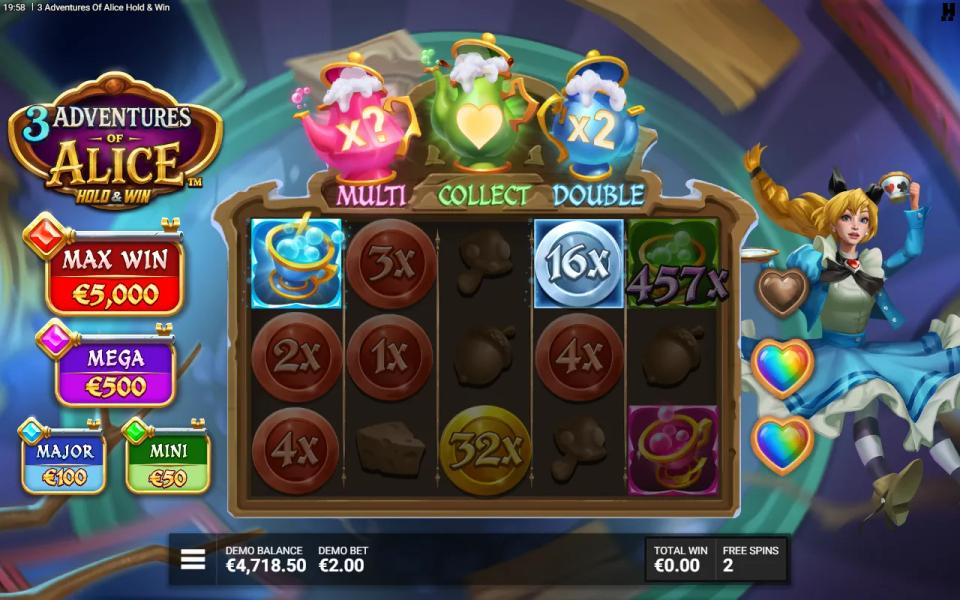
You can bypass the base spins entirely. The Bonushunt mode costs five times the stake for ten times the trigger chance, but the prizes remain locked at the base bet, and the jackpot signs on the layout don't move to reflect the higher cost. A 100x buy guarantees one to three cups, while a 200x premium guarantees two to three and nudges the return up to 96.34%.

Next to a title like The Jade Path Hold & Win, which runs the same cap on the same board at a slightly lower 96.19% return, what is left to tell them apart is what the teapots do. The 2,500x cap might seem small compared to a 15,000x game like Fortune Balloons from Amigo Gaming, but it sits comfortably above the 1,380x limit of Playtech's Gold Trio: Tres Amigos. Because that top prize exists as a single jackpot marker rather than a total you have to grind toward, it's a target you could actually hit in one drop, making the cap feel entirely reachable.
The design inside the round is solid. The hidden multiplier on the pink cup creates genuine tension, and a green sweep turning a dead board into a fresh start is a great mechanic. But the constraints are sharp. The pink multiplier can't affect jackpot markers, and if it sits outside the three-by-three window of a loaded green collect cup, it can't multiply that total either. So the one thing that can multiply by ten is barred from the top prize. And because an operator can set the return as low as 86.29%, with nothing on screen to say which rung you have been handed, you might be playing a much harsher math model than the default. A board without the green cup fills once and stops, and that is where a 100x purchase has its value decided: ours arrived without it and still came back at 196x, near enough double the price, but on a single fill with no second act. The one that came in with all three pots closed at 565x. The difference between a round that opens up and one that pays once is mostly whether the green pot wakes up, and paying double for the higher buy is the price of a better chance at seeing it.
Played and reviewed by the SlotsReach editorial team · Published 19 Sept 2026