
Fenix da Lava Slot Review
by Popok GamingReleased May 22, 2026
Specifications
| Game Type | Slots |
|---|---|
| RTP | 96.54% |
| Volatility | Low |
| Max Win | 5,000x |
| Grid | 3-5-3 |
| Paylines | 15 fixed |
| Min Bet | $0.1 |
| Max Bet | $100 |
| Hit Freq | 10.93% |
A confused approach to volatility
PopOK Gaming has a habit of pushing out slots that sit slightly outside the usual templates, but Fenix da Lava takes that tendency and ties it in knots. The coin-collect hold-and-win genre is crowded, and studios usually differentiate their releases by either jacking up the volatility or flooding the matrix with constant, tiny features. This online slot tries to claim the latter while structurally enforcing the former. It's a game that hands out a low volatility label while starving the board of action, creating a strange disconnect between what the release claims to be and how it actually handles a balance.
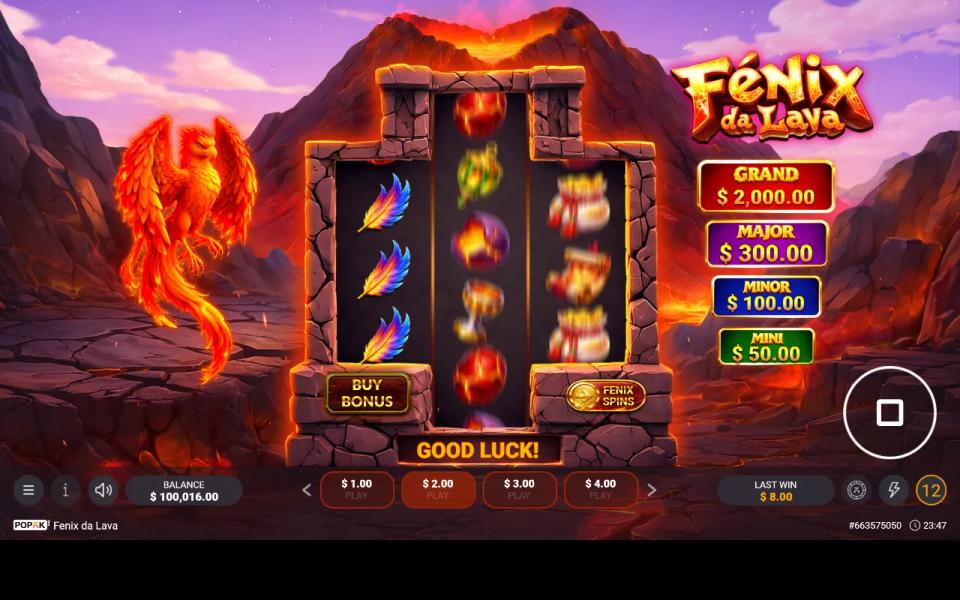
The premise here is a tiny stone archway built over a volcano, stripping the standard video slot down to its barest bones. It relies entirely on the tension of a single central column. The design feels less like a fully fleshed-out world and more like a mechanical trap designed to isolate the game's one defining feature.
The figures map out a very specific kind of machine. Fenix da Lava plays across an eleven-cell grid with three reels, where the middle column stands a row taller at the top and bottom than the outer two. It runs fifteen fixed paylines and requires three of a kind for any win. The game publishes a 96.54% RTP that stays flat across the base game, the bonus buys, and the side bet. Volatility is officially labeled low, yet the hit frequency sits at a punishing 10.93%, the lowest published rate of any PopOK game we carry a figure for. The maximum win is capped at 5,000x the stake, supported by a fixed 1,000x GRAND jackpot.
Stacking the multipliers
The base game paytable exists mostly to keep a balance ticking over. The wild phoenix head pays 25x for a full line, while gold ingots manage 15x. Four of the nine regular symbols return 2x or less. Because the wild explicitly doesn't substitute for coins or the Collect symbol, the highest-paying tile on the layout is completely locked out of the main feature.
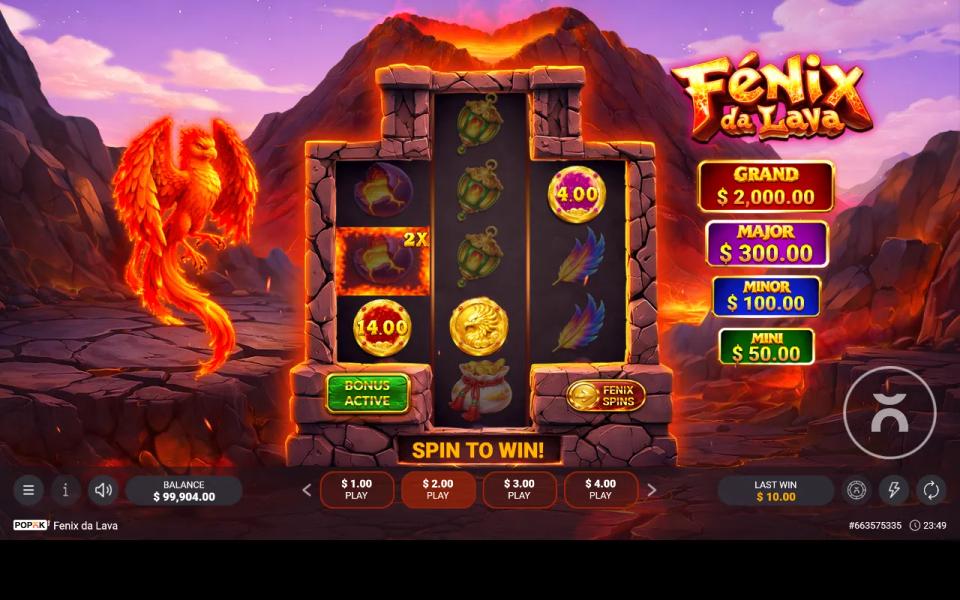
To trigger the bonus round, the grid demands a coin on the left reel, a coin on the right reel, and the Collect symbol in the middle, all landing at once. Landing a Collect beside just one coin simply cashes that single value, awarding a few bet multiples before the spin ends. The Collect symbol frequently drops onto the central column entirely on its own, often stacked two high, sweeping nothing at all from the empty outer reels.
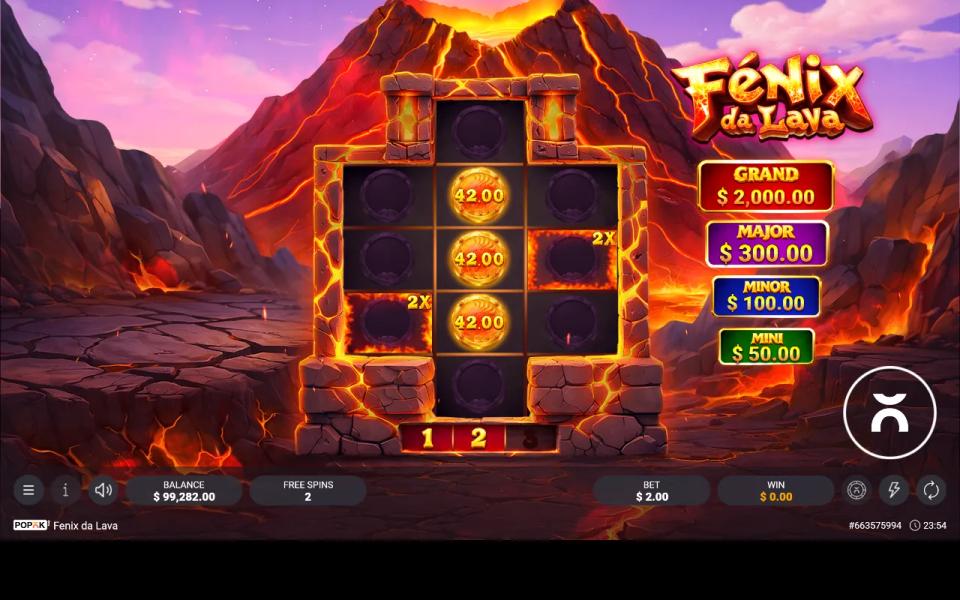
When the full trigger does hit, the regular paytable switches off. The matrix clears for a hold-and-win round that relies on coins, Collects, and jackpot coins, starting with three respins that reset every time a new value lands. The round doesn't automate itself, requiring a manual press for every single respin. The Collect symbol on the middle reel transforms into a running total, absorbing every coin that hits the outer columns. The volcano erupts to drop 2X cells onto the outer reels, doubling any coin that lands on them before it gets added to the center. Stack multiple Collects down that middle column, and each one counts every single coin separately, turning a modest board into a heavily multiplied payout. The jackpots are fixed bet multiples ranging from a 25x MINI to the 1,000x GRAND, riding on the faces of the coins themselves to be collected just like the standard cash values.
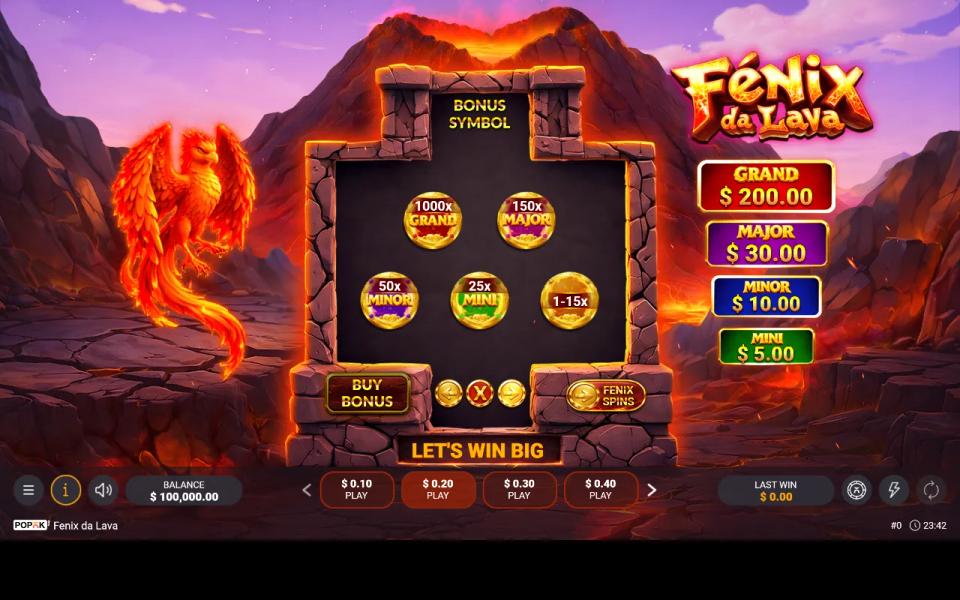
The game sells access to this round through three distinct bonus buys at 50x, 100x, and 250x, and they act as entirely different purchasing options rather than scaled versions of the same feature. You're paying for the opening board configuration. A 50x buy can easily limp home with a fraction of its cost, dropping a congratulatory overlay onto a single-digit return. The 100x tier opens with more coins and might climb to a third of its price. The 250x option is where the engine actually flexes, starting with stacked Collects and active 2X cells that multiply incoming coins several times over, though even a heavily extended round here can still close out at roughly half of what it cost to enter. Alternatively, a side bet called Fenix Spins charges 15x per round to guarantee a coin and a Collect on every board. Because a full trigger requires three parts, this side bet often just cashes a single small coin for a steep loss, offering a very expensive way to chase the actual bonus.
The reality of the math
PopOK's own Clover Tree x30000 PRAG carries the exact same low volatility label but runs a 52.79% hit rate, making the 10.93% hit frequency here look completely misjudged. Compared to the wider market, Fenix da Lava feels even stranger. Pragmatic Play's Heartbreakers runs a similar low-volatility hold-and-win round at a nearly identical 96.53% RTP, but it pays on 17.83% of spins and caps at 10,000x. Gamzix's Lava Power: Hold the Spin shares the volcano theme and the respin mechanic, but drops the return to 94.03% with a 2,000x cap. Octoplay's Break the Vegas Piggy offers another low-volatility coin-collect that caps at 2,250x. Microgaming's Phoenix Blaze takes the same mythical bird into a hold-and-win format, but honestly commits to high volatility and a 10,000x cap at a 96.05% RTP.
What Fenix da Lava does quite well is the mechanical interaction inside its feature. The stacking Collect totals combined with the 2X cells create a genuinely entertaining multiplication engine, and a 5,000x maximum win is a perfectly reachable target for a math model designed around exponential counting. The fixed 1,000x GRAND jackpot sitting on a single coin gives the feature a solid anchor.
But the base game is an absolute desert, paying so rarely that the layout is usually doing nothing at all. The purchasing options are brutally segmented, walling off the actual potential of the stacked Collects behind the 250x premium tier. Paying 50x for a barren starting board or bleeding 15x a spin on a side bet that mostly just refunds small change makes the entire economy feel somewhat predatory. It's a slot that forces you to buy the most expensive option just to see the mechanics work properly, which is a pretty steep demand from a game that calls itself low volatility.
Played and reviewed by the SlotsReach editorial team · Published 14 Sept 2026