Sugar Rush Slot Review
by Pragmatic PlayReleased Jun 30, 2022
Specifications
| Game Type | Slots |
|---|---|
| RTP | 96.5% |
| RTP Range | 96.50 / 95.50 / 94.50 |
| Volatility | High |
| Max Win | 5,000x |
| Grid | 7x7 |
| Min Bet | $0.2 |
| Max Bet | $240 |
| Hit Freq | 34.48% |
The paytable cannot get you there, and that is the point
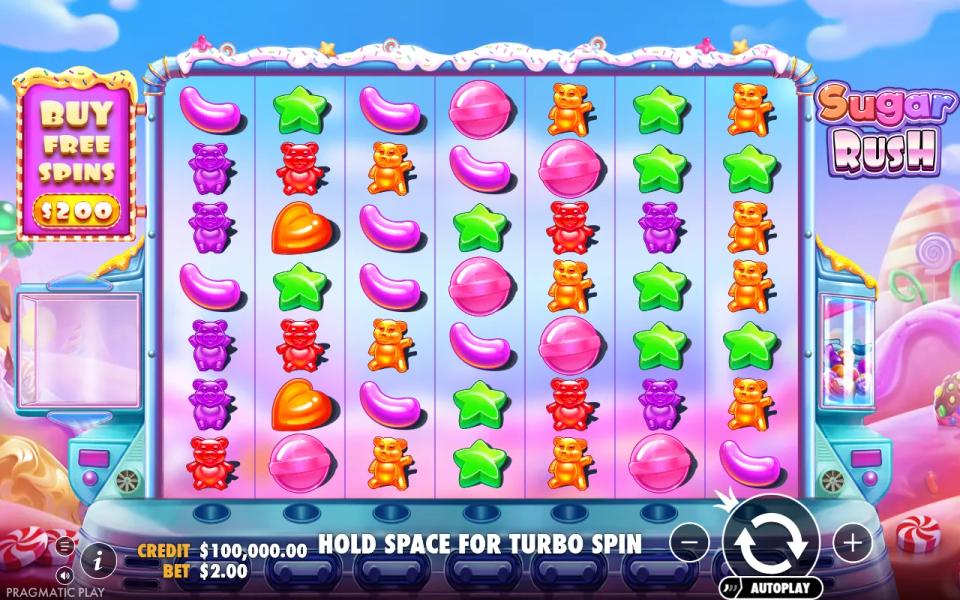
Sugar Rush is a 7x7 cluster slot from Pragmatic Play where five or more matching sweets touching horizontally or vertically pay out. The winning symbols burst, new ones drop in, and the whole thing repeats until no more wins land.
Look at what a cluster is actually worth, though. Five pink lollipops, the best symbol in the game, returns your stake, while five of the orange gummy bear returns a fifth of it. To reach 150x you need fifteen lollipops in one single cluster on a grid of forty-nine cells.
The game advertises 5,000x. Everything between those two numbers has to come from somewhere else, and it does. The reels are not where this game keeps its money, but rather a delivery mechanism for what happens underneath them.
The base game keeps wiping the board
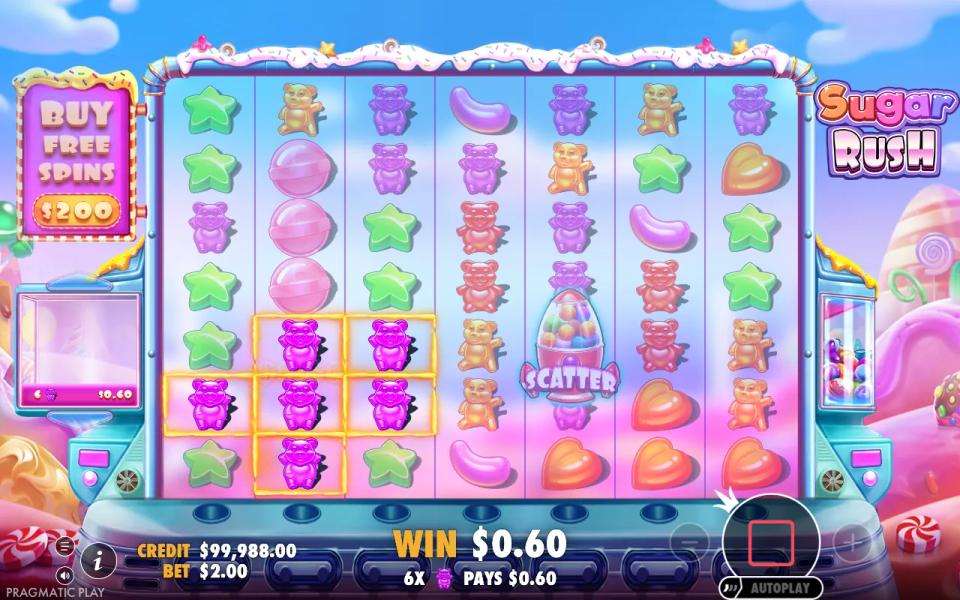
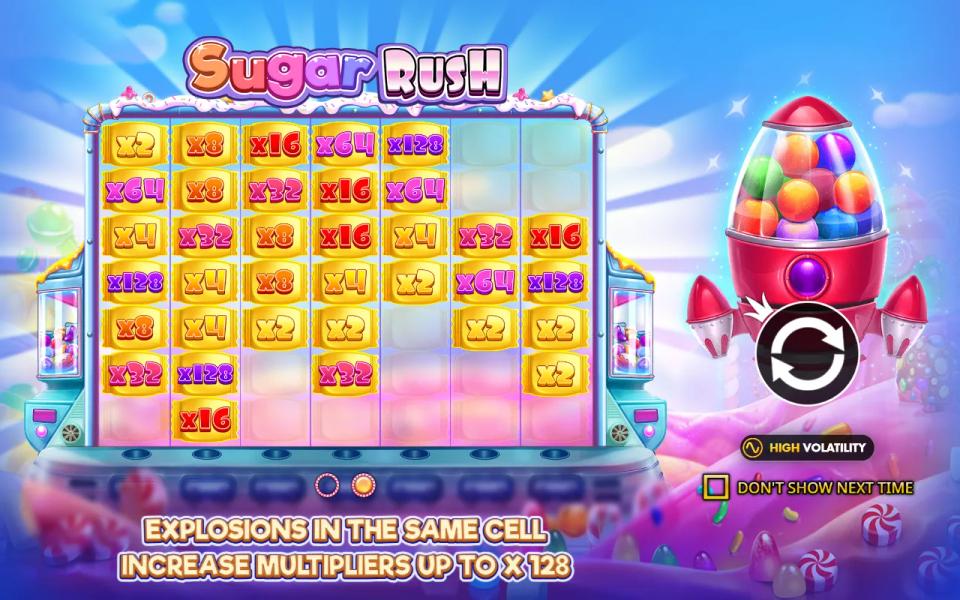
Every time a cluster pays, the cells it occupied get marked with a highlighted square. If a winning symbol is removed from a cell that is already marked, that mark becomes a x2 multiplier. Win there again and it doubles to x4, then x8, and so on up to x128, with any multiplier sitting under a winning cluster applying to it.
The problem is that all of this is thrown away when the tumbling stops. Marks and multipliers only last until the sequence ends, leaving the board clean again for the next spin. A base spin has to build and cash in inside one sequence, and most of them do not get anywhere.
The hit rate is about one spin in three, which sounds generous until you see what a hit is actually worth. We mostly just see small clusters of low symbols paying a fraction of the stake back, while cells reach x2 and vanish before they do any good.
Doubling and adding
Two details make the multipliers work, and it is the combination that matters most. The first is that they double rather than climb. A cell that has been part of four wins reads x8 instead of x4, meaning repeated punishment of the same square escalates the numbers fast.
The second is that when several multipliers sit under one cluster, they add together rather than compound. Five cells at x8 make a x40, not a x32,768.
Put those together and you get a very specific shape of big win. It is rarely a lucky single spin, but rather a wide cluster landing late on ground that has already been chewed up several times over. Deep multipliers on a few cells are worth less than moderate multipliers spread across many because the cluster has to cover them to pay.
The bonus is a board that remembers
Three scatters give you 10 free spins, with four giving 12, five giving 15, six giving 20, and seven giving 30. One rule changes on the way in, and it makes the entire feature.
Marks and multipliers stay on the grid for the whole round rather than resetting after a single tumble sequence. Every spin adds to what the last one built, turning the round into a slow accumulation. The board usually starts thin, but by the final few spins we often see it covered in golden tiles with numbers on them topping out at x64.
The round can retrigger on the same scatter counts to extend the accumulation rather than restarting it. Left to itself, the bonus arrives about once in 323 spins, which makes the next section a real question rather than an impatient one.
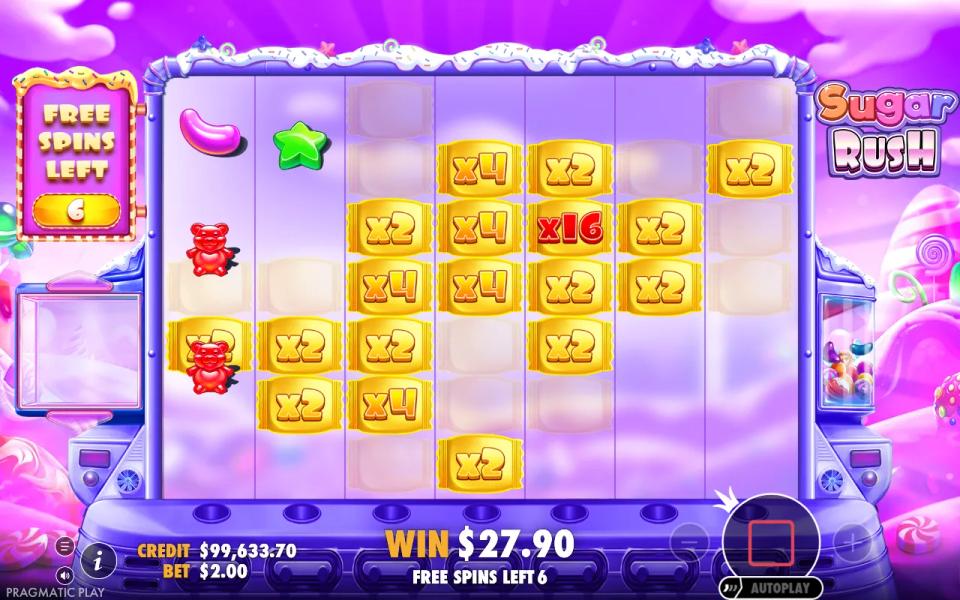
What a 100x buy actually costs
The buy costs 100 times your stake and drops you straight into the free spins with the scatter count drawn at random. You are paying for entry and not for size, meaning you will often just draw three scatters and get the smallest award of 10 spins.
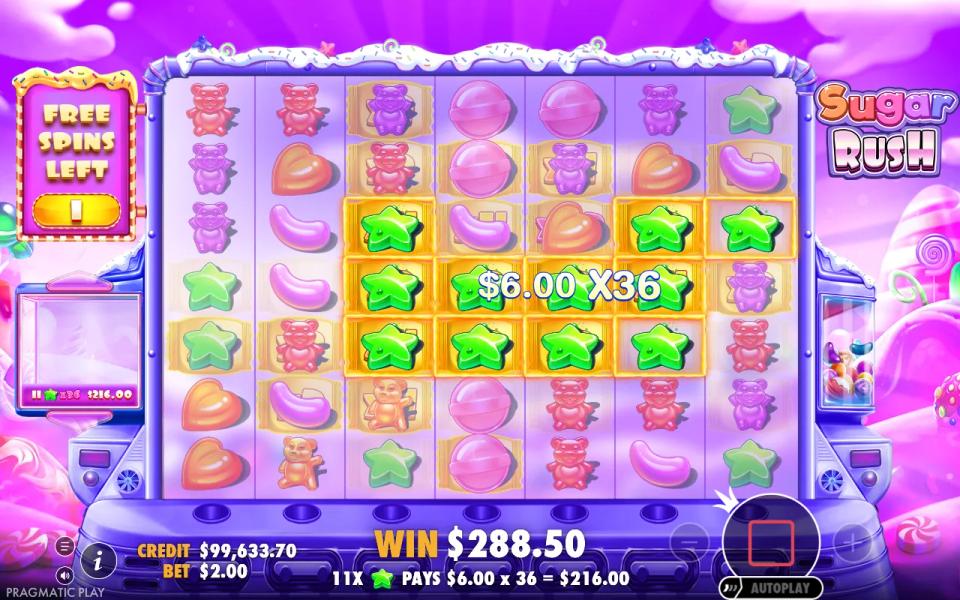
The returns from this are wild. A quiet round might hand back a quarter of what it cost, while a good one builds slowly before exploding on the final spins. When a late cluster lands across the worn part of the board, the game prints its own arithmetic right on the screen. Watching it calculate that eleven green stars pay 6.00, multiplied by 36, for a 216.00 win shows exactly how the board pays out when the multipliers finally align.
One thing worth knowing before you buy is that the RTP does not change. The game runs at 96.50% whether you spin in or pay in. That is an unusual detail stated plainly in the rules, as most bought features charge a premium on the return.
The ceiling is a cliff
The maximum is 5,000x the bet in both the base game and the free spins, and it is a hard cap rather than a big number nobody has reached.
What happens when you touch it is the interesting part, because the round ends immediately. The win is paid and every remaining free spin is forfeited, meaning a 5,000x hit on the second spin wipes out twenty-eight spins you had already been awarded. The odds of that are published and they are worth reading twice: about one round in 2,340,000. That figure describes Sugar Rush far better than the 5,000x does.
It is also worth holding the ceiling next to something like Whale Rush, which plays on the same 7x7 cluster grid and tops out at 10,000x. Sugar Rush is not a game you play for the size of its maximum, but for how the board fills up on the way.
A clever engine in a generic wrapper
This is a genuinely good mechanic wrapped in a completely generic Candyland theme full of jelly sweets and bouncy music. The idea underneath it is better than the wrapping deserves. A grid that accumulates damage and pays you for revisiting the same ground feels incredibly satisfying to build.
The design is at least honest about what it is, as the base game does not pretend to be worth playing for its own sake. The bonus really is a different game rather than the same game for free, and the buy costs nothing extra in theoretical return.
The main complaint is that spinning the base game is a long and largely pointless wait for something that happens once in 323 spins. This is a game that wants you to buy the bonus, and it is priced and structured accordingly. Four years on it has spawned three sequels and a whole line of imitators, proving just how well this engine actually works.
Played and reviewed by the SlotsReach editorial team · Published 5 Sept 2026