Micro Knights Slot Review
by ELK StudiosReleased Feb 25, 2020
A 7x7 cluster game where symbols shoved off the grid stack up in a queue to help build later wins. The brilliant mechanics make losing a row something to celebrate, even if the top prize feels a bit light for the effort required to reach it.
Specifications
| Game Type | Slots |
|---|---|
| RTP | 96% |
| Volatility | Medium |
| Max Win | 2,500x |
| Grid | 7x7 |
| Paylines | Cluster Pays (5+ connected symbols) |
| Min Bet | $0.2 |
| Max Bet | $100 |
| Hit Freq | 36.9% |
Building a cluster off the board
ELK Studios built a 7x7 cluster game and then put the most interesting part of it outside the grid. Symbols shoved off the reels here do not vanish. They line up on a stone road running away from the bottom of the board, stacking up by type and waiting to count towards your clusters. It turns losing a row into something you actively want to happen. The game runs at 96% RTP and pays on 36.9% of spins, which keeps the board moving constantly.
The absolute ceiling is 2,500x. That number ends up being the main argument against an otherwise brilliant setup.
How the knights feed the queue
The basics follow the usual rules. Five or more matching symbols touching horizontally or vertically will pay, vanish, and trigger a cascade. Everything above drops down to fill the gap, and the drops keep running until no new clusters form.
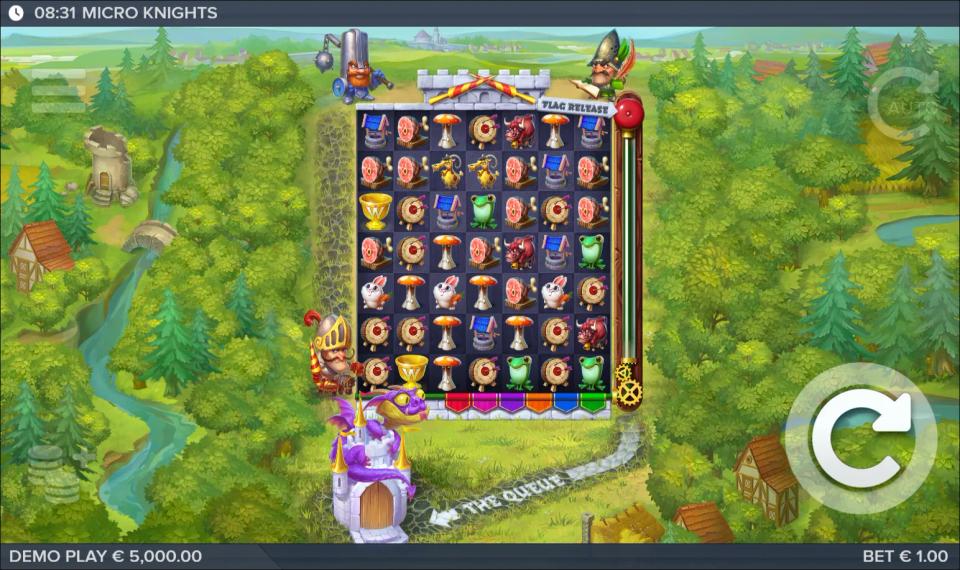
The queue on the stone road is what changes the rhythm. Those stacked symbols are live, meaning when a cluster starts forming on the grid, matching symbols in the queue join it. Four frogs on the board plus two frogs on the road creates a paying cluster of six.
Two of the three knights standing around the frame exist just to feed this mechanic. The Charging Knight runs across the board and shoves a whole row onto the road, leaving wilds and bonus symbols behind. The Smashing Knight simply adds one to every stack already queued, fattening the road without a single symbol leaving the grid. Queued symbols stay put until they pay out, the bonus starts, or the round ends.
Chasing flags up the meter
Every symbol in a winning cluster feeds a meter up the right side of the board. Fill it, and the Collecting Knight hands over a flag. The escalation of this meter is the single most useful thing to know about how a session plays. The first flag costs twenty symbols, the second costs thirty, the third forty, and every flag after that costs another ten on top. Flags come quickly at the start of a hot round and then slow to a crawl right when you want them most.
There are six flags, and they arrive in a strict order. Inferno sends the dragon across the board to burn off low-value symbols. Extra Wilds drops between three and fifteen golden chalices at random. Super Size lands one oversized block that acts as a 2x2, 3x3, or 4x4 symbol. Charge pushes two to five rows onto the road at once.
The final two flags are the real targets. Epic Charge pushes the entire board onto the road, and Boosted Queue lets every stack on the road connect to the grid independently at the exact same time. Reaching both in one round means feeding the meter through five increasingly expensive refills, which is exactly the run you will spend most of your session chasing.
Five drops that save your progress
Three bonus symbols anywhere on the board start the free drops. You only get five of them, which sounds like a joke until you notice what carries over. The meter does not reset between drops, and neither does the queue. Whatever you had built when the scatters landed is still standing, and the five drops keep pouring into it.
This means the value of the bonus depends entirely on when it turns up. Land it on a cold board with an empty meter, and you get five ordinary drops. Land it mid-cascade with a loaded road and three flags already banked, and the drops become the tail end of a massive run. The bonus symbol itself is a blocker during the base game, paying nothing and acting as an obstacle until the third one finally shows up.
Flat paytables and a low ceiling
Look at how the paytable is shaped and the 2,500x ceiling makes sense. The payouts have massive flat spots where growing a cluster does nothing for your balance. Ten and eleven bulls both pay 1,750 coins. Twelve, thirteen, fourteen, and fifteen bulls all pay the exact same 3,500 coins. Sixteen through nineteen all pay 7,000.
You do not see another jump until the twentieth symbol lands and the cluster pays 25,000. That twenty-symbol bull cluster is the best single hit the paytable offers, and it equates to 250x your stake. You do not get near the top with one enormous board. You get there with one round that refuses to die, where Epic Charge dumps the grid onto the road and Boosted Queue slams it back repeatedly. Stakes run from 0.20 to 100 across twelve fixed levels, and there is no buy button, so there is no shortcut to any of it.
Squinting at farm animals
The kingdom is drawn from directly overhead, dropping the board into a green pine forest with a river and a few red-roofed cottages. The reel frame is a castle wall with crossed jousting lances. It is warm, slightly ridiculous, and has aged well. The high-paying symbols are stressed farm animals, featuring a bull, a goat wearing a bell, a rabbit clutching a carrot, and a screaming frog.
The low payers are where the visuals cause a real problem. They include a slab of meat, a water well, a mushroom, and an archery target. Four of the eight symbols are brown or beige, meaning they all read as the same muddy smudge at a quick glance. On a 7x7 board that is constantly cascading and shifting rows into the queue, losing track of what is landing costs you the ability to follow the action.
Epic Charge into Boosted Queue is the best thing in this game, and the 2,500x ceiling is what stops it from mattering. A mechanic capable of emptying a massive grid onto a road and firing all of it back out should be attached to a bigger number than a top cluster worth 250x. Everything else is handled brilliantly. The knights do real heavy lifting, the escalating meter gives the round a clear shape, and the bonus persistence is incredibly smart. We would send anyone here who has grown tired of cluster slots where a dead board means a dead spin, because pushing symbols entirely off this grid does more work than most spins that actually pay.
Played and reviewed by the SlotsReach editorial team · Published 31 Jul 2026 · Updated 24 Aug 2026