22 free demo slots with medieval theme
Knights, castles, swords, and siege warfare. Medieval slots bring the Middle Ages to life with jousting bonuses and royal courts. A theme that never goes out of style.
Blueprint Gaming
Microgaming
Pragmatic Play
Endorphina
ELK Studios
ELK Studios
ELK Studios
ELK Studios
Pragmatic Play
ELK Studios
Pragmatic Play
ELK Studios
Pragmatic Play
Play'n GO
Pragmatic Play
ELK Studios
Hacksaw Gaming
ELK Studios
ELK Studios
ELK Studios
ELK Studios
Pragmatic Play
The single most important slot innovation of the last decade - the Megaways engine, with its variable reels and up to 117,649 ways to win - launched inside a medieval game almost nobody plays anymore. Dragon Born by Big Time Gaming dropped in 2016 with knights, crests, and a dragon on a six-reel grid that shifted symbol counts per spin. The game flopped commercially. Bonanza Megaways, released months later with a mining theme, became the monster hit. But the engine was conceived, tested, and debugged in a medieval shell. At around 95% RTP with high volatility, Dragon Born is a historical curiosity more than a daily driver now. Its significance is entirely mechanical.
That pattern - medieval themes as testbeds for new ideas that other themes then commercialize - runs through the whole category. Castle Builder (Rabcat, 2013) pioneered RPG-slot hybridization years before gamification became an industry buzzword. Avalon II (Microgaming, 2014) packed eight sequential bonus mini-games into a single slot before narrative design was a conference talking point. The medieval setting, with its built-in quest structures and hero progression arcs, naturally supports the kinds of mechanical experimentation that flat themes like fruit or gems simply cannot.
About 220 to 300 medieval slots exist across major directories, depending on where you draw the line between medieval and fantasy. That places the theme solidly in the mid-tier - smaller than Egyptian (which has four to five times more games), Viking, or Irish, but larger than niche categories like Cyberpunk or Easter. The quality-to-filler ratio is better here than in most comparable themes. No studio has flooded the space with reskins the way Pragmatic Play saturated Greek mythology or the way Novomatic spawned endless Book of Ra descendants.
If one studio owns the medieval slot category, it's Play'n GO - and the ownership is narrow. Their entire medieval portfolio orbits King Arthur. The Sword and the Grail (2019) sits at the center: 96.53% RTP, high volatility, 10,000x max win, with a progressive free spins system that advances your multiplier wilds from 2x through 5x, 10x, and up to 100x as you move from Squire to King rank. That escalation mechanic creates genuine tension. Every free spin round feels like it has momentum.
The 2024 sequel, The Sword and the Grail Excalibur, pushes max win to 25,000x and volatility to the ceiling - Play'n GO rates it 10 out of 10. RTP drops slightly to 96.20%. The wandering wilds and instant prize additions give it more surface variety, but the core loop feels iterative. Play'n GO essentially took the original formula and cranked the numbers up without rethinking the design.
Around this pair, Play'n GO built an entire Arthurian Legends collection: The Green Knight (2021, 96.27% RTP, 10,000x), Return of the Green Knight (2023, 96.27%, 40,000x - the category's biggest max win by far), Rise of Merlin (96.58%, 5,000x, basically a Book of Dead reskin with Arthurian art), Lord Merlin and the Lady of the Lake, Clash of Camelot (roughly 96.2%, 35,000x), Merlin's Grimoire, Diamonds of the Realm. Seven or eight Arthurian games from one studio.
The concentration has two consequences. First, Play'n GO's Arthurian series is legitimately strong - Sword and the Grail and Return of the Green Knight are two of the best high-volatility slots released in any theme. Second, the concentration makes the entire medieval category feel like it's about one mythology. Castles, crusades, medieval commerce, feudal warfare, the Black Death - all virtually untouched. The Arthurian lens is so dominant that browsing "medieval slots" in most catalogs produces page after page of Excaliburs, Merlins, and Holy Grails. It gets repetitive fast.
Avalon II: The Quest for the Grail remains the most ambitious narrative slot ever built, a decade after release. Microgaming gave it eight bonus stages - Lake of Legend, Misty Vale, Whispering Woods, Hall of Shadows, Morgan's Keep, Isle of Avalon, and two more - each with distinct mechanics. One is a trail bonus, another a pick-and-click, another a free spins variant with shifting multipliers. The whole thing plays like a quest where each bonus feeds into the next. At 95.92% RTP and medium volatility, the math is forgiving enough that you actually reach the later stages regularly. Max win is 16,200x, which on medium volatility is enormous.
The game looks dated now. Flash-era graphics, small symbols, limited animation. Microgaming (now Games Global) has made no effort to remaster it. For a slot this mechanically interesting, that neglect is frustrating.
Castle Builder II (Rabcat, 2017) is the strangest slot in any category. You pick one of three characters, travel through 15 kingdoms, build 75 castles by collecting materials on the reels, and choose marriage partners for princesses in pick-and-click ceremonies. It has over 300 characters and 26 minutes of original orchestral music. The RTP starts at 95.5% and rises to 97.75% as you complete cup challenges - a dynamic payout structure that barely exists anywhere else in the industry. As a slot, the base game payouts feel thin. As a hybrid between an RPG and a slot machine, nothing else comes close.
Medieval slots share a visual weakness that limits their mass-market appeal. The dominant palette - stone grey, iron black, torchlight amber, muted purple - creates a look that reads as muddy on phone screens. Egyptian slots pop with gold and lapis lazuli. Norse slots have electric blue lightning and aurora effects. Greek games lean into white marble and Mediterranean sky. Medieval? Dark interiors, armored figures, castle walls. The art direction is period-appropriate and often well-executed, but it lacks the instant visual contrast that drives casual engagement.
Dragon Born's reel symbols were so generic - dark crests, indistinct knights, vaguely red dragons - that nothing visually stuck. Compare that to Dead or Alive 2's iconic wanted-poster aesthetic or Gonzo's Quest's animated protagonist. Medieval slots struggle to create visual identity because the theme's iconography (shields, swords, castles, crowns) is broadly similar across dozens of games.
The exceptions reinforce the point. The Sword and the Grail's golden chalice motif against a deep blue background gives it a distinct look. Castle Builder's bright kingdom maps and character portraits break completely from the stone-and-iron default. Return of the Green Knight uses a saturated forest-green palette that immediately separates it from the pack. These games found visual identities outside the medieval cliché. Most don't bother.
The less crowded corners of the medieval catalog hide some solid games.
Robin Hood: Shifting Riches (NetEnt, 2011) introduced the shifting reels mechanic - a proto-cascading system where wins move the "money bags" across reels toward Robin's side. At 96.75% RTP and low-medium volatility with a 5,260x max win, it's the strongest option for players who want medieval theming without high-variance swings. NetEnt's recent Ms Robin Hood updates the concept with expanding rows (4 to 8), giving it a modern Megaways-adjacent feel.
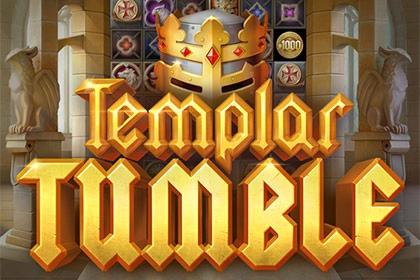
Templar Tumble (Relax Gaming, 2020) brings a Crusade setting to a cascading 6x7 grid where blocker symbols are destroyed on each tumble, gradually opening the full board. High volatility, around 96% RTP. The sequel Templar Tumble 2 Dream Drop adds a progressive jackpot.
Knights of Avalon (Red Tiger) runs a daily jackpot system with three tiers. Excalibur Unleashed (Pragmatic Play, 2024) uses a diamond grid with expanding multiplier wilds, at 96.05% RTP and high volatility - serviceable but formulaic by Pragmatic's usual pattern of recycling proven mechanics across themes. Knight's Life (Merkur, 95.84%, high volatility) transforms knight symbols into wilds through a progressive system, though its 2,000x max win cap feels low by current standards.
At the bottom of the category, generic filler from micro-studios drags the average down. Urgent Games released a title literally called "Medieval Slots" with an RTP range extending to 85% and persistent crash bugs. These low-effort entries exist in every theme, but medieval's smaller total catalog means they're proportionally more visible.
Play'n GO ships all its games with multiple RTP configurations. The Sword and the Grail defaults to 96.53% - but operators can select tiers as low as 84.63%. For the most popular games in the medieval category to carry that kind of variance between casinos is a problem specific to this theme's provider landscape. Because Play'n GO dominates medieval so thoroughly, the RTP tier issue affects a disproportionate share of the games players actually want to try. Avalon II (Microgaming) and Robin Hood: Shifting Riches (NetEnt) run fixed RTPs, which makes them increasingly attractive by comparison as the industry trend toward configurable payouts accelerates.
Medieval produced two of the five most mechanically innovative slots in industry history (Castle Builder, Avalon II), hosted the birth of Megaways, and generated one of the strongest high-volatility series of the 2020s (Sword and the Grail line). For a theme with fewer than 300 games, that record is absurd. The Arthurian fixation and the dark-palette problem keep it from mainstream popularity, but the quality ceiling here is as high as any category in the industry. Play'n GO's Return of the Green Knight at 40,000x max win sits in a tier with the most aggressive slots ever designed, and Avalon II's eight-stage quest bonus has still never been replicated.
The whole Crusades period, the Hundred Years' War, medieval trade routes, castle siege warfare - none of it has been properly explored. The theme has a millennium of source material and the industry keeps going back to Camelot. Someone is going to figure that out eventually.