October Pub Slot Review
by EvoplayReleased Oct 3, 2023
Free demo - play instantly in your browser
Pour beer into up to 5 glasses, hitting multiplier marks from x2 to x100. Collect anytime or risk it all for a bigger pour.
Specifications
| Game Type | Instant Win |
|---|---|
| RTP | 96% |
| Volatility | Medium |
| Max Win | 500x |
| Min Bet | $1 |
| Max Bet | $75 |
October Pub Slot Overview
Pour beer into a glass, watch it climb past marks worth x2, x5, x12, x30 and x100, and stop before the tap runs dry. That is October Pub in full. There is not a reel anywhere in it, because Evoplay built this one for Oktoberfest 2023 as an instant game: no paylines, no symbols, no free spins, just a tap and a nerve test.
What saves it from being a one-button toy is that five glasses run at once. Each carries its own stake, its own pour progress and its own Collect button, and a COLLECT ALL sweeps the lot when the round has gone far enough. Bank one at x2, leave a second climbing, push a third at the top mark, switch between them whenever.
RTP is a flat 96.00%, the round resolves in seconds, and every decision in the game is the same decision: pour again, or take the money.
Theme & Design
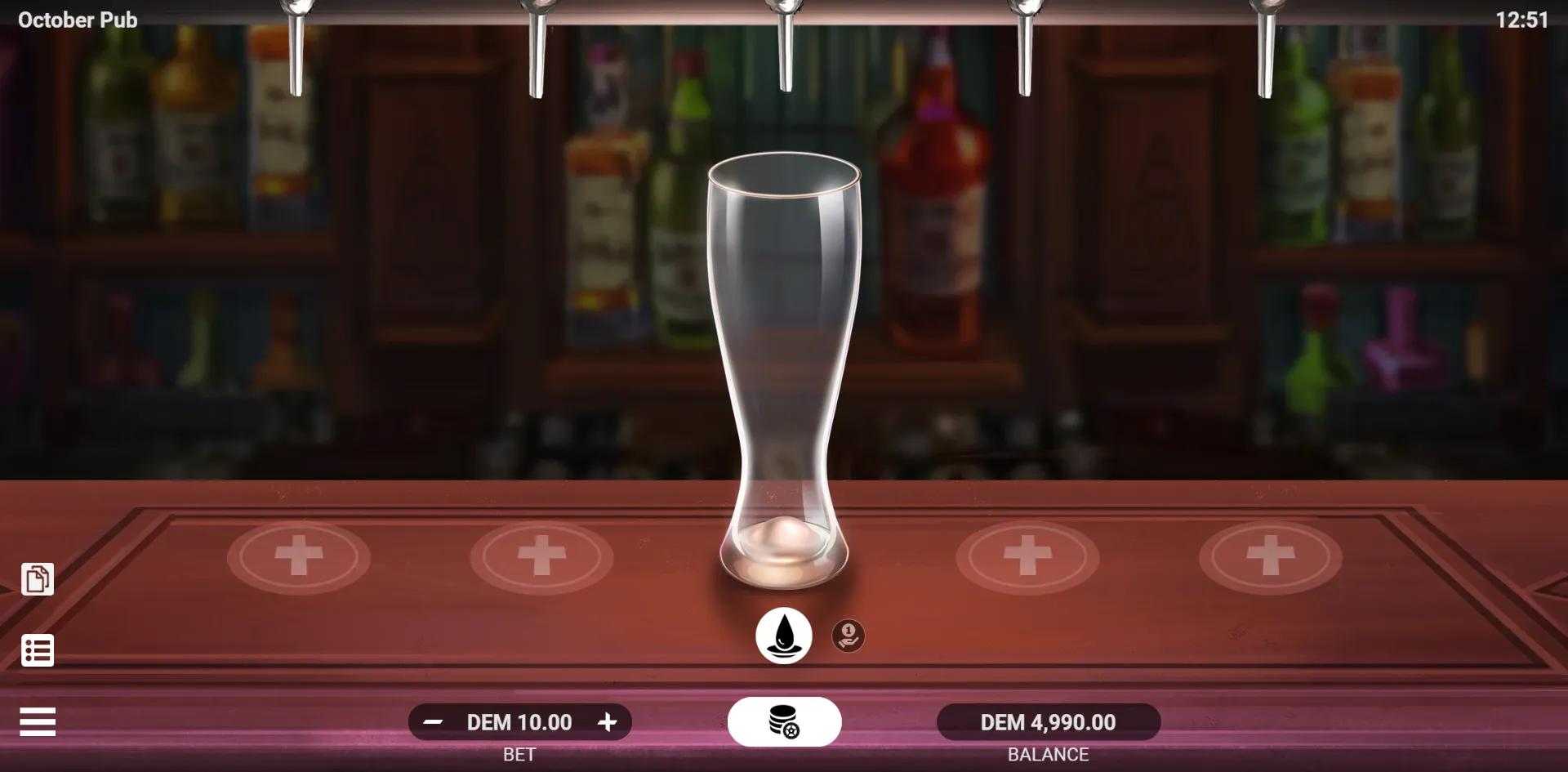
The bar is the entire set. Five chrome taps hang in a row along the top, a wall of softly blurred bottles glows behind them (a fat red one, green glass, whisky labels catching the light), and a mahogany counter with routed panel lines runs along the bottom under a warm pink wash from the bar rail. The four inactive stations sit on that counter as faint plus circles, waiting to be filled.
The glass does the real work. A tall weizen with a pinched waist, level marks etched down its side, the mark just reached burning orange while the next one up glows green and the amber beer with its bubbled head rises toward it one pour at a time. It looks good. Warm, properly painted rather than clip-art cheap, and the hop cones and wooden signboard on the logo sell the beer festival without shouting about it.
Symbols & Paytable
| Symbol | Payout |
|---|---|
| First mark, x2 | 2x that glass's stakethe only mark reachable from an empty glass |
| Second mark, x5 | 5x that glass's stakeone pour past the first mark |
| Third mark, x12 | 12x that glass's stakeroughly the halfway point of the glass |
| Fourth mark, x30 | 30x that glass's stakewhere most players start hovering over Collect |
| Top mark, x100 | 100x that glass's stakethe brim; five glasses filled this far is the 500x ceiling |
Features & How They Work
Pour and collect, and nothing else
Stake a glass, hit the droplet button, and the beer jumps toward the next mark. Clear it and the glass is worth that multiplier, at which point the choice is Collect or pour again. If the beer runs out before the mark is reached, that glass loses everything stacked in it, not just the last increment. Progress is not banked at each rung; it rides until it is taken.
There is no auto mode to hide behind and no bonus round waiting somewhere. The whole game is that one button and the discipline to stop using it.
Five glasses, five separate decisions
A round holds up to five glasses, activated from the plus circles on the counter, and each is funded and resolved on its own. Own stake, own ladder position, own Collect. That means a player can cash one glass at x2 to cover the round, let a second sit at x12, and run a third at the top mark with nothing riding on it emotionally except the third glass.
Most games of this shape hand out one ladder and one decision. Running five in parallel is the one design idea here that other cash-out titles do not copy, and it is what makes a session feel like management rather than a coin flip.
The ladder is priced so no stopping point is better than another
Evoplay quotes a single RTP, 96.00%, for a game in which the player picks the stopping point. For one number to mean anything under those conditions, expected value has to be identical at every rung; otherwise the return would swing with strategy and no single figure could be published at all. Take that as the assumption and the odds drop out of the ladder by arithmetic.
At 0.96 of the stake at every level: 48.0% to reach x2, 19.2% for x5, 8.0% for x12, 3.2% for x30, and 0.96% for x100, or about one glass in 104. Converted into per-pour survival, the shape sharpens. The first pour lands 48.0% of the time, then 40.0% from x2 to x5, 41.7% from x5 to x12, 40.0% from x12 to x30, and 30.0% on the last jump from x30 to x100. Four pours in ten survive at every step except the final one, where it falls to three. That top rung is the mean one, and it sits precisely where a player's nerve was going to wobble anyway.
The conclusion is the useful part. No collect point beats any other. Cashing at x2 every time and hammering for x100 every time both return 96% over the long run, so the only thing under a player's control here is variance, not value. All of this is derived from the published RTP rather than printed by Evoplay, so read it as arithmetic rather than a spec. (A hit frequency of 1.48% floats around in listings for this game, near the derived 0.96% without matching it, and the metric barely applies to a game with no spins to hit.)
What the 500x headline is actually measured against
The 500x ceiling holds up three ways over: the game's own settings return it, the demo build caps at 15,000,000 against a 30,000 top bet, and Evoplay has stated a maximum win of 500x the stake in trade coverage. It fits the structure too, since five glasses at x100 each comes to exactly 500.
The part nobody flags is what that 500 is measured against. Every glass is staked separately. Five glasses filled to the brim pay 500 times what went into one glass, and 100 times what went into all five. A player who funds the full set and maxes every one has turned their actual outlay into 100x. The number is honest arithmetic on a single glass, but it is not the multiple of what the player put on the counter.
One loose end worth stating plainly: some listings record a 1,000x maximum multiplier and a 75,000 cash ceiling against a 75 maximum bet. A five-glass ladder capped at x100 per glass cannot produce 1,000x, so that figure does not reconcile with the game as it is built. 500x is the engine number.
Provably fair
Each round is verifiable through SHA-256 hashing, so a player can check after the fact that the outcome was fixed before the first pour. Evoplay's slots do not carry this, and it matters more here than it would on reels: there is exactly one decision loop, the failure is invisible (the beer simply stops), and a player pushing at x30 has no other way to satisfy themselves that the pour was not weighted against the amount sitting in the glass.
Screenshots
How October Pub Plays
Rounds last seconds. Tap, the beer jumps, and either it clears the mark or the pour dies and the glass empties. No spin animation to sit through, no feature to wait for, which puts the pacing closer to a coin-flip game than to anything with reels, and makes the whole thing sharply faster than it looks.
Running one glass at a time gets dull inside ten minutes, honestly. Running five is where the game finds a rhythm: something banked, something mid-climb, something being pushed too far, all resolving on separate clicks. It gives a round texture that a single ladder never would.
The tension is entirely self-inflicted, which is the design working as intended. Nothing in the game argues for stopping at any particular mark, so the stopping rule is pure psychology, and the pull is worst at x30 with the brim one pour away. That is where the money goes. One practical note on cost: the floor is 1 per glass, ten times the 0.10 minimum on Evoplay's slots, so a five-glass round starts at 5 and a cautious player cannot sit down cheaply.
Pros & Cons
Pros
- Five glasses run independently with their own stakes and Collect buttons, so one can be banked while another rides
- Every collect point returns the same 96% long term, so there is no trap and no wrong choice, only a variance dial
- Provably fair via SHA-256, which Evoplay's slot catalogue does not carry
- Warm, well-painted pub art and a clean one-tap interface
Cons
- The 500x headline is measured against a single glass's stake, not the five-glass outlay a player actually funds
- Evoplay publishes neither the volatility, the full ladder, nor what happens when a pour fails, in a game whose only skill is knowing when to stop
- Minimum 1 per glass is ten times the floor on the studio's slots, so a five-glass round costs 5 to start
- The loop is short and repetitive by design and a single glass wears thin fast
Is October Pub Worth Playing?
The most useful thing about October Pub is the thing least advertised: the ladder is priced so that no stopping point beats another. There is no correct strategy to miss and no trap to fall into, just a choice between many small wins and the roughly 1-in-104 chance of a full glass. Evoplay says none of this, and does not even publish the rules that would make it obvious, which is a poor showing for a game built entirely around knowing when to quit.
Credit where it belongs: the five-glass structure is a proper idea. Most cash-out games give a player one ladder and one nerve test, and this runs five in parallel with independent Collect buttons, which changes how a round feels rather than just how it looks. The art is warm, the hashing is a fair extra. Against that, the loop is thin and repetitive, the 500x flatters what a player actually stakes, the 1,000x figure floating in listings does not add up, and there is almost nothing written about this game anywhere, which says something about the traction it found.
Frequently Asked Questions
What is the maximum win in October Pub?
What is the RTP of October Pub?
Is October Pub a slot?
How often does a glass reach the x100 mark?
What volatility is October Pub?
Is October Pub suitable for players under 18?

Reviewed by Arina, PR & Content Manager
PR & Content Manager at SlotsReach
Published 2 Aug 2026 · Updated 2 Aug 2026