Plinko Blast Slot Review
by EvoplayReleased Aug 26, 2025
Free demo - play instantly in your browser
Plinko ball-drop game with adjustable 8-16 row pyramids, 3 difficulty tiers, and up to 500x multiplier on the outer baskets at High risk.

Specifications
| Game Type | Instant Win |
|---|---|
| RTP | 96.08% |
| Volatility | Medium |
| Max Win | 500x |
| Grid | instant |
| Min Bet | $1 |
| Max Bet | $75 |
| Hit Freq | 100% |
Plinko Blast Slot Overview
Drop a ball into a pyramid of pegs, watch it clatter left and right on the way down, and take whatever multiplier sits in the basket it lands in. That is the entire game. Evoplay's August 2025 version gives the player two dials on top of that: the pyramid can be set anywhere from 8 to 16 rows, and a Low/Medium/High switch reshapes the row of baskets underneath it.
Plinko is unusual among casino games because it can be solved outright. Each peg is a coin flip, so the ball's path is a string of independent left-or-right decisions and the odds of every basket follow from that. With all 27 multiplier tables (nine field sizes times three difficulties) it is possible to compute exactly what each setting returns and how often. Evoplay publishes none of it. What the studio does publish is a return quoted as a range, 96.01-96.08%, and the x500 headline.
Bets run from 1 to 75, ten times the floor on the studio's slots. There is no bonus round, no buy feature, no ante and no jackpot, and there was never going to be one.
Theme & Design
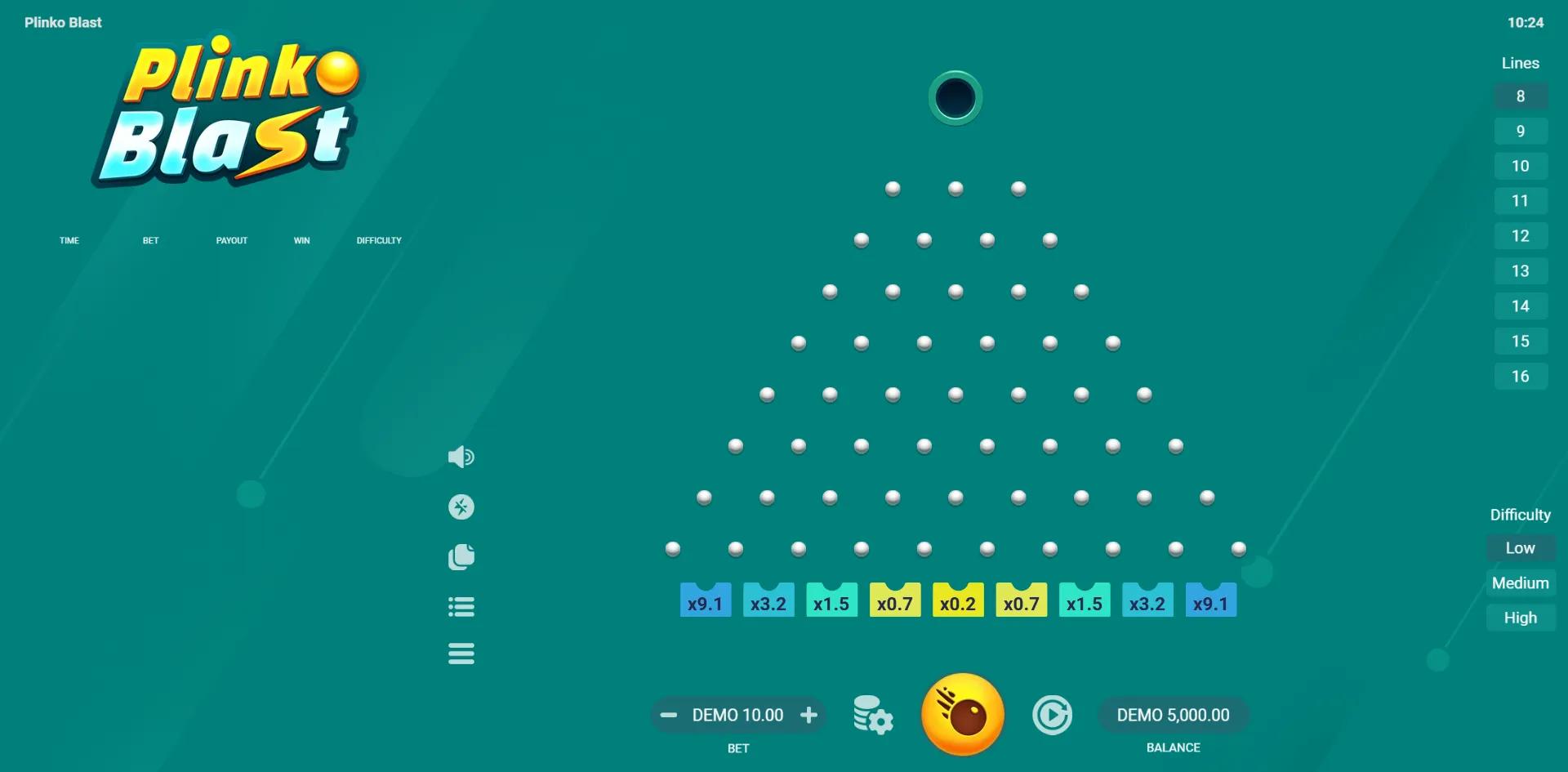
Flat teal, and almost nothing else. The background is a single turquoise wash with a few faint diagonal light streaks and pale green orbs drifting across it, which leaves the white pegs and the golden ball as the only things the eye has to track. The logo is the loudest object on the page: chunky 3D lettering in yellow and ice blue, with the O of Plinko replaced by the ball itself and a lightning bolt kicking off the S. The ball has a dark dimple in it, like a tiny bowling ball.
Baskets are colour coded by value, cyan at the edges, green through the middle ranks, yellow and red for the ones that hand back less than the stake, so the shape of the payout curve is readable at a glance without reading a single number. Peg hits throw off small teal-green sparks. Left of the pyramid sits a history column headed TIME, BET, PAYOUT, WIN, DIFFICULTY; the right rail stacks the line counts 8 through 16 above the three difficulty buttons. It is clean and it is legible, which for a game whose whole job is showing one ball falling is the right call. Nobody will remember the art.
Symbols & Paytable
| Symbol | Payout |
|---|---|
| 8 rows, Low | 9.1x, 3.2x, 1.5x, 0.7x, 0.2x, 0.7x, 1.5x, 3.2x, 9.1xComputes to 96.02%. The 0.2x centre basket collects 27.34% of all drops, so better than a quarter of balls return a fifth of the stake. |
| 8 rows, High | 23.9x, 5.9x, 1x, 0.3x, 0.2x, 0.3x, 1x, 5.9x, 23.9xAlso 96.02%, and identical to Low on every frequency: 71.1% of drops below stake, 7.03% at 2x or better. Only the spread of the payouts moves. |
| 12 rows, High | 67x, 9.7x, 3.4x, 1.7x, 0.9x, 0.7x, 0.4x, 0.7x, 0.9x, 1.7x, 3.4x, 9.7x, 67x96.02% return, yet 85.4% of drops come back under the stake. The harshest setting in the game for frequency and one of the best for return. |
| 15 rows, Low | 62x, 17x, 6x, 2.3x, 1.4x, 1.2x, 1x, 0.5x, 0.5x, 1x, 1.2x, 1.4x, 2.3x, 6x, 17x, 62x96.01%, and the gentlest setting in the game: only 39.3% of drops lose money. |
| 15 rows, High | 500x, 30x, 8.7x, 3.3x, 1.5x, 1.2x, 0.7x, 0.5x, 0.5x, 0.7x, 1.2x, 1.5x, 3.3x, 8.7x, 30x, 500x96.05%. Two 500x baskets across 32,768 possible paths, which is one every 16,384 drops. |
| 16 rows, High | 500x, 33x, 6x, 3.3x, 1.5x, 1.2x, 1.1x, 0.8x, 0.3x, 0.8x, 1.1x, 1.2x, 1.5x, 3.3x, 6x, 33x, 500x96.00%. The same two 500x edges, but spread across 65,536 paths, so half as often as at 15 rows. Its 0.3x centre is the single likeliest outcome in the game at 19.64%. |
Features & How They Work
The field: 8 to 16 rows, three difficulties
Rows are set from 8 up to 16, which gives 9 up to 17 baskets along the bottom. Difficulty is a separate control with Low, Medium and High, and it swaps the whole row of multipliers for a different set. Every table is symmetric, tall at the outer edges and shallow in the middle, so the ball is always fighting to escape a centre it is statistically drawn towards. Twenty seven combinations in total, switchable between drops, no unlocking and no cost. The in-game rules describe all of this in one line: field size and risk impact basket multipliers. That is as specific as the studio gets.
The whole game is solvable, and the numbers check out
A ball falling through N rows makes N independent left-or-right decisions, so the chance of it finishing in basket k is C(N,k) divided by 2 to the power N. That is a binomial distribution, and it assumes every peg is a fair 50/50 bounce. Pair it with the actual multiplier tables and every return in the game falls out arithmetically.
Run it across all 27 tables and each one lands between 96.00% and 96.08%. Evoplay's published band is 96.01-96.08%. Twenty seven separate tables all landing inside the studio's own stated range is about as strong a confirmation of the fair-peg assumption as anyone is going to get without a server log, and it also says the tables are tuned properly rather than thrown together. The published floor is a hair generous, since 16 rows on Medium and High both compute to 96.00% flat, but that is splitting hairs.
Both dials change the shape, neither changes the price
Across all 27 settings the return moves by 0.08 of a percentage point. That is nothing. What does move, enormously, is how often anything happens: the share of drops returning less than the stake runs from 39.3% at 15 rows Low all the way to 85.4% at 12 rows High. A forty six point spread in frequency against a rounding error in value.
So a player fiddling with rows and difficulty is picking variance, not picking a better deal, and the game says nothing at all about this. It is also a neat demonstration of how little a return figure tells a player on its own. 12 rows High is one of the better-returning settings in the game and simultaneously the one that loses money on the highest share of drops.
At 8 rows the difficulty switch does nothing measurable
On the smallest field, Low, Medium and High all return 96.02%. All three put 71.1% of drops below the stake. All three return 2x or better on 7.03% of drops. The only thing the switch touches is how extreme the two edge baskets are: 9.1x on Low, 20.3x on Medium, 23.9x on High, with the centre pinned at 0.2x throughout.
On an 8-row field the difficulty selector is a payout-spread control and nothing more. It changes what a good drop is worth, never how often a good drop happens.
Chasing the 500x: take 15 rows over 16
The 500x basket exists in exactly two of the 27 tables, 15 rows High and 16 rows High, with one at each edge. At 15 rows there are 32,768 possible paths and two of them pay 500x, so roughly one drop in 16,384. At 16 rows there are 65,536 paths and still only two 500x baskets, so one drop in 32,768.
The 15-row setting is precisely twice as likely to pay the advertised maximum. It also returns marginally more overall, 96.05% against 96.00%. Same top prize, double the frequency, better return, and no downside. The game presents 16 rows as its biggest and most extreme field, and on the one measure a max-win chaser cares about it is the worse of the two. That is the single most useful thing anyone can know about this game and it appears nowhere in the game.
Provably fair, and a history panel
Each drop is verifiable through SHA-256 provably fair hashing, which is more accountability than the studio's slots give and a sensible fit for a format where the player is meant to trust a bounce. Evoplay's own page for the game does not mention it. A Bets History panel logs time, bet, payout, win and difficulty for recent drops, useful mostly for checking what a given setting has actually been doing over a run.
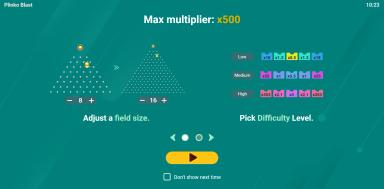
One oddity on the way in: the tutorial cards illustrate the three difficulties with sample baskets topping out at x18, x55 and x353, and showing a 0x in the centre of the High example. No table in the game contains a 55x or a 353x, and no basket anywhere pays zero, since the lowest value in any of the 27 tables is 0.2x. Illustrative rather than accurate.
Screenshots
How Plinko Blast Plays
Fast, and then faster. One click launches a ball, and a second click does not wait for the first to land, so a session can turn into a stream of balls falling through the pegs at whatever rate the mouse can manage. Autoplay does the same thing without the wrist strain. There is no build-up, no anticipation phase, nothing that accumulates between drops.
What it actually feels like is a slow leak with occasional interruptions. On the bigger fields roughly one drop in five parks itself in the centre basket and hands back 30% of the stake, and the baskets either side of it are barely better, so most of the time the balance ticks down in small unremarkable increments while the ball does something visually pleasant. The tension lives entirely in the outer two or three baskets, and the ball almost never gets there, which is exactly what the shape of the pyramid guarantees.
The choice of setting matters more for mood than for money. At 15 rows on Low the balance holds roughly steady for long stretches and the game feels almost placid; on the harder narrow fields the history column fills with red before anything interesting happens. Both cost the same. For my money the small fields wear out quickest, since the payouts are compressed and the difficulty switch is not actually doing anything, so the whole thing collapses into watching a ball bounce eight times.
Pros & Cons
Pros
- Publishing the return as a 96.01-96.08% range instead of one number is more candid than most studios manage, and all 27 tables land inside it
- 27 field-and-difficulty combinations give the player direct, free control over variance
- SHA-256 provably fair verification, which the studio's slots do not offer
- Clean minimal presentation that keeps the ball readable, which is all this format needs
Cons
- No odds and no multiplier tables published anywhere for a game that is pure probability
- Nothing in the game tells a player that the two dials barely move the return at all
- 16 rows is framed as the biggest setting but is the worse of the two for chasing the 500x
- The quoted 100% hit frequency is technically true and completely uninformative, since most baskets pay under the stake
- One-click loop with nothing to unlock, learn or build towards
Is Plinko Blast Worth Playing?
As a piece of design this is thin by definition, and that is the format rather than a failure. What lifts it above the pile of identical Plinko clones is that the tables underneath are honestly tuned. Every one of the 27 settings returns what the studio says it returns, which is not something you can say about a lot of what gets shipped, and the quoted range instead of a single tidy number reads like a studio that did the arithmetic rather than one picking a marketing figure.
The frustration is what the player is left to guess. Twenty seven settings, a forty six point swing in how often drops land below the stake, and no indication anywhere that the choice is about variance rather than value. Anyone going after the x500 should be on 15 rows High, not 16, and the game will never tell them. It works, it is fair, and it is as plain as casino gaming gets.
Frequently Asked Questions
What is the maximum win in Plinko Blast?
Which setting gives the best chance of hitting the 500x?
What is the RTP of Plinko Blast?
Does Plinko Blast have a bonus round or a buy feature?
Can Plinko Blast be played for free, and is there an age limit?

Reviewed by Arina, PR & Content Manager
PR & Content Manager at SlotsReach
Published 2 Aug 2026 · Updated 2 Aug 2026